Cebu-based Aznar Shipping Corporation (Aznar) is acquiring three brand-new ships as part of its expansion plans, which include preparations for a potential foray into the ship repair and drydock business as the family-owned shipping line aims to evolve into an operator whose capabilities extend beyond the regional market and establish a broader presence across the country, leveraging its robust financial growth.
Kyle Alexander C. Aznar, president and CEO of the Aznar family corporation, said during a media meet-and-greet session on Monday that the investment in the new vessels ordered from China is substantial. However, he declined to disclose the amount, noting that prices fluctuate depending on steel costs.
The company sources ships from China because they are more cost-effective and have shorter delivery times. Local shipbuilders, such as Tsuneishi Shipbuilding of Japan located in Balamban, Cebu, do not cater to the type of vessels commonly used in the Philippines, as they focus on ocean-going vessels that can cost as much as USD 50 million.

Routes
Aznar Shipping currently serves 10 ports of call across the Visayas, including Escalante near Bacolod in Negros, Palompon and Isabel in Leyte, Cebu, and Bantayan Island. Its fleet of 10 ships currently makes at least three trips a day.
“Right now our short-term plan is mostly in the Visayas because that’s where we see the most growth,” he said, adding that the company will focus on connecting Bacolod to Iloilo and Tabuelan to Escalante, where it sees the greatest potential.
“So we’re connecting Negros. We’ve been there for quite some time and that’s the area we’ve been expanding the most. We’ve been buying bigger ships there,” he said.
With the cargo business booming over the last three years, the company has decided to exit passenger operations on some routes and shift to landing craft transport (LCT) operations for the Bacolod–Escalante–Tabuelan route, where each trip can carry up to 35 container trucks.
In fact, the Tabuelan route is already 90 percent cargo. The new ships will triple the capacity of the company’s existing second-hand Japanese vessels, which can carry only nine container trucks.
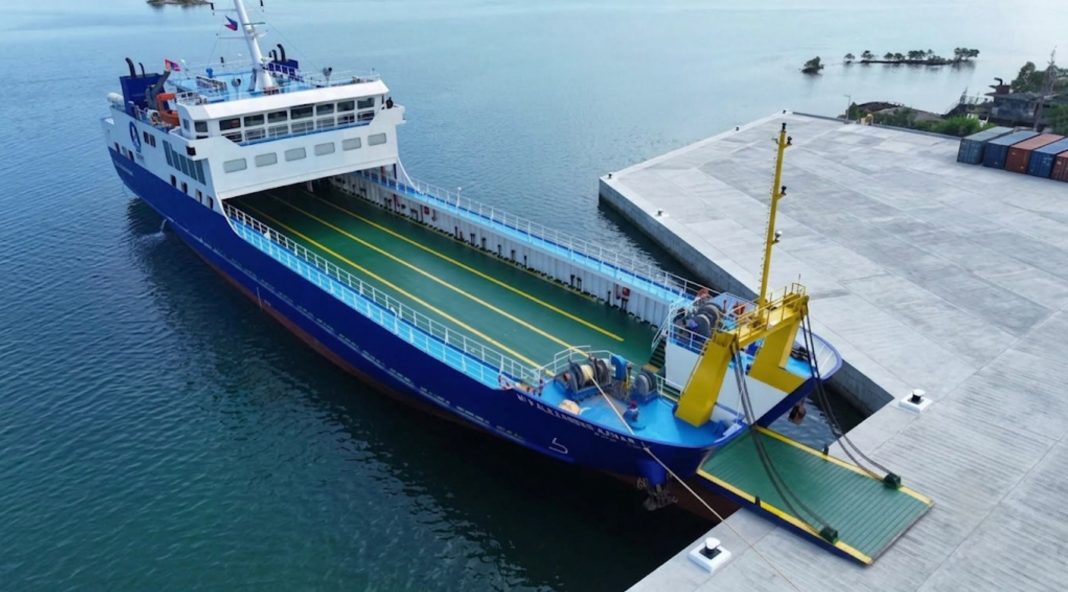
In May this year, Aznar expanded its fleet with the arrival of its brand-new RoRo vessel, MV Alexander Aznar I. The vessel is certified by the International Association of Classification Societies (IACS) and operates on the Danao, Cebu–Isabel, Leyte route and vice versa.
“Through this IACS-class vessel, we are strengthening our ability to serve the growing movement of people, vehicles, and goods between Cebu and Leyte. MV Alexander Aznar I allows us to reduce travel time from four hours to three hours, increase capacity, and provide a more reliable transport option for passengers and cargo customers,” said Aznar.
MV Alexander Aznar I significantly improves the company’s passenger and cargo capacity on the Danao–Isabel route. The vessel can accommodate up to 340 passengers per trip, approximately 60 percent higher than the combined passenger capacity of the vessels previously deployed on the route.
It can also carry 14 units of 10-wheeler wing vans and 24 four-wheel vehicles, equivalent to 22 units of 10-wheeler wing vans per trip. This represents a 37.5 percent increase in cargo-carrying capacity compared with older vessels. The dedicated allocation for four-wheel vehicles also better matches the route’s historical cargo mix, where around 70 percent of cargo traffic consists of four-wheel vehicles.
Overall, Aznar’s shipping business is composed of 70 percent cargo and 30 percent passenger operations.
Ship Repair and Shipbuilding
With its expanding fleet, Aznar said the natural next step is to venture into shipbuilding and ship repair facilities. At present, there is a shortage of shipyard facilities in the country, while the Maritime Industry Authority (MARINA) requires vessels to undergo drydocking every 2.5 years.
For its own requirements alone, a fleet of 15 ships would mean that approximately seven vessels must undergo drydocking each year. The company currently spends at least PHP15 million annually on drydocking to ensure operational efficiency.
“It’s a sellers market,” he said, while also urging the government to provide incentives for local ship repair and shipbuilding projects.
The company is considering Cebu, Negros, and Leyte as possible locations for the planned facility and has already received various land offers for the project.
Should the plan proceed, Aznar said the facility will not only service its own vessels but will also cater to other shipping lines.
Robust Financials
In terms of financial performance, Aznar said the company expects volume growth this year to surpass last year’s double-digit increase. This makes Aznar one of the fastest shipping line operating in the Visayas region.
“Despite what happened, despite the more difficult environment, despite the higher inflation, despite the higher fuel, we’re not affect, we improve our able volume even,” he said, adding that the company has been able to absorb rising costs with the support of MARINA, which has been proactive in assisting the domestic shipping industry through a 20 percent fuel surcharge mechanism.
For the first quarter of the year, the company grew its revenue by nearly 80 percent, or PHP81 million, while net income more than doubled, rising 114 percent to PHP17 million compared with the same period last year.
For the full year 2025, Aznar Shipping generated PHP225 million in revenues and ended the year with PHP51 million in profit.
The company hopes to expand beyond the Visayas and establish a stronger presence across Luzon and the Visayas over the next five years.