


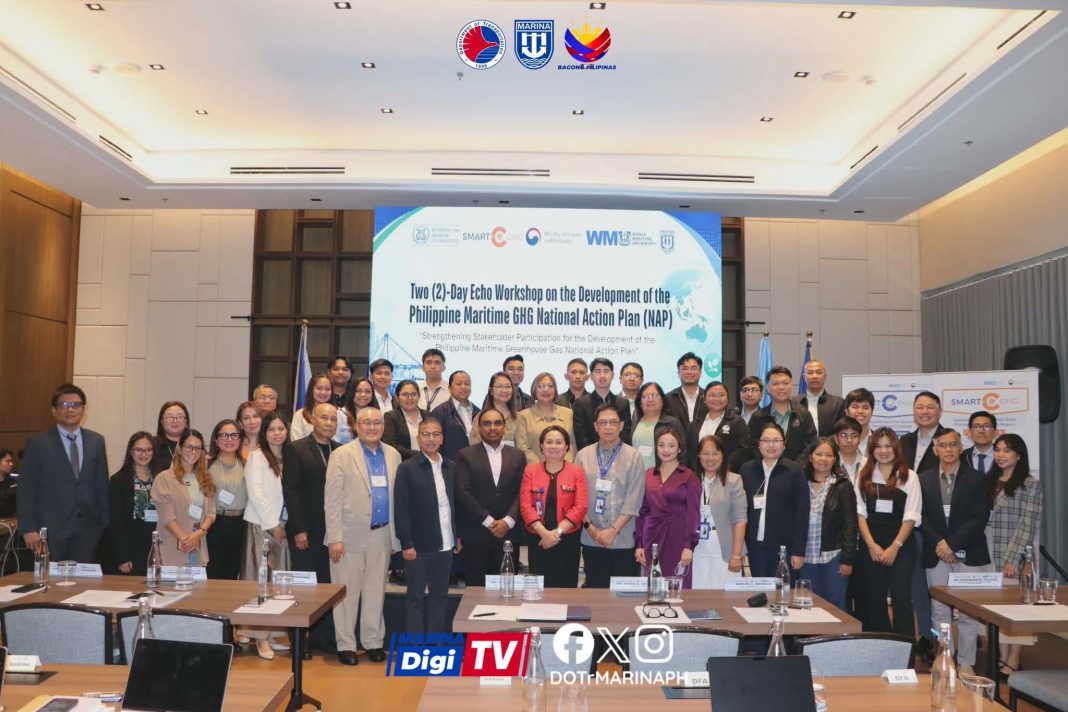
In a major stride toward marine environmental protection, key government agencies and private maritime stakeholders converged for a two-day echo workshop held on June 15–16, 2026.
The collaborative forum focused on developing the Philippine National Action Plan for the Reduction of Greenhouse Gas (GHG) Emissions in the Maritime Industry (NAP-GHG).
The workshop was hosted by the Maritime Industry Authority (MARINA), in strategic partnership with the International Maritime Organization (IMO), the Ministry of Oceans and Fisheries of the Republic of Korea, and the World Maritime University (WMU). The primary objective of the event was to gather diverse stakeholder inputs, validate baseline data, identify existing industry gaps, and formulate actionable recommendations for the national strategy.
MARINA Administrator Sonia Malaluan underscored the necessity of a unified front, noting that the workshop establishes a shared understanding of the SMART-C GHG Project objectives. She emphasized that the initiative serves as a vital platform to reaffirm the country’s commitment to safer, cleaner, and more efficient maritime operations.
“When our environment calls for protection, we answer as one single community,” Malaluan stated, praising the combined expertise of the public and private sector leaders who will comprise the newly formed National Task Force.
The initiative aligns closely with international climate goals. In a recorded address, IMO Project Manager for the SMART-C GHG Project, Yingming Wang, emphasized that the global maritime decarbonization agenda has entered a critical phase following the adoption of the 2023 IMO GHG Strategy.
Wang lauded the country’s proactive stance, stating: “The SMART-C GHG Project support to the development of the Philippine Maritime National Action Plan is timely and strategic. [The] Philippines’ actions can make an important impact not only to the national sustainable objectives but also to the global maritime decarbonization agenda.”
Moving forward, the implementation of the strategy will be driven by the National Task Force for the SMART-C GHG Project in the Philippines. This specialized body will hold the mandate for the development, finalization, official adoption, and long-term enforcement of the NAP-GHG.
Through this milestone workshop, the Philippines reinforces its position as a proactive leader in regional marine preservation and sustainable maritime transport.

