


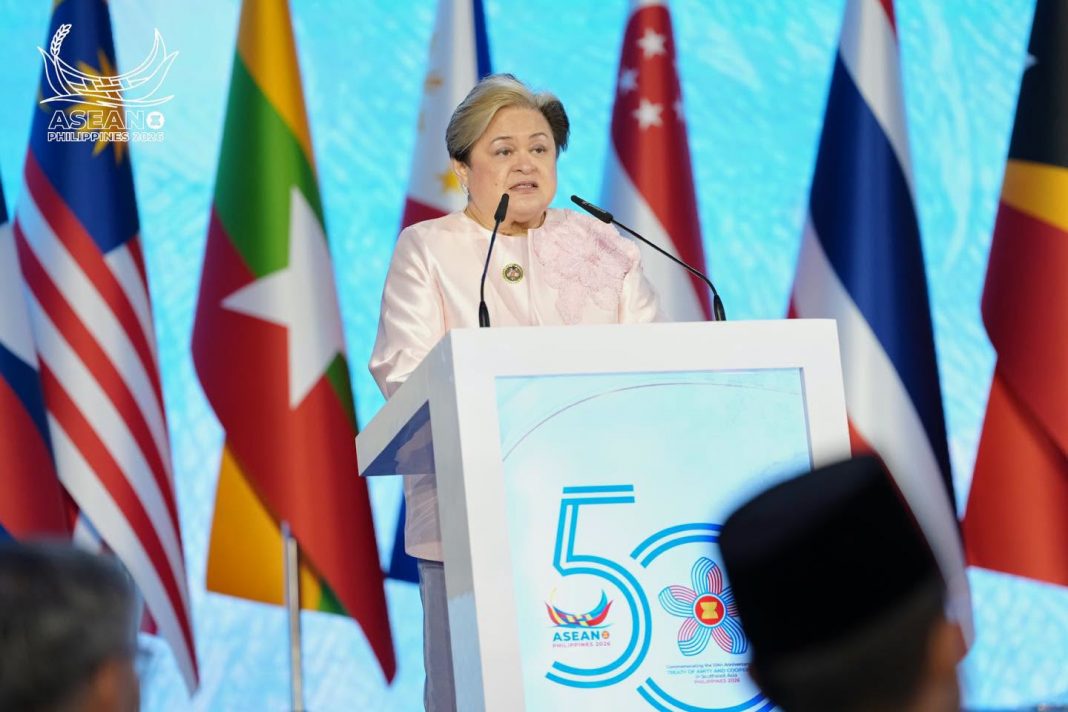
The Philippines hosted the historic first-ever High-Level Conference of High-Contracting Parties to the ASEAN Treaty of Amity and Cooperation (TAC), marking the 50th anniversary of the landmark 1976 agreement.
Held under the Philippines’ ASEAN Chairship 2026 at the Philippine International Convention Center (PICC), the milestone event focused on strengthening conflict prevention, preventive diplomacy, maritime security, and collaborative approaches to emerging global threats.
Delivering the keynote address, Philippine Foreign Affairs Secretary Ma. Theresa Lazaro welcomed four new accessions to the treaty—Sweden, Poland, Romania, and Lithuania—expanding the TAC’s global community to 62 High Contracting Parties representing nearly three-quarters of humanity.
Secretary Lazaro credited the TAC as the primary catalyst for Southeast Asia’s transformation over the last five decades.
“Over the past five decades, peace transformed Southeast Asia from a region of turmoil into a global economic powerhouse, a vibrant market, and an engine of innovation,” Secretary Lazaro stated. “Our journey proved one fundamental truth: economic prosperity does not happen by accident. It is made possible only under the indispensable conditions of peace.”
Emphasizing the diplomatic framework of the treaty, Secretary Lazaro highlighted the Filipino concept of kapwa—a shared inner self or neighborliness—as a universal principle that transcends physical geography and binds nations through shared values and mutual respect.
“Neighborhood is not defined by geographic distance; it is defined by shared values and common aspirations,” Lazaro said. “When you view one another through the lens of ‘kapwa,’ physical distance evaporates. We become true neighbors in a shared world.”
A key outcome of the conference was ASEAN’s formal adoption of the Guidelines on the Modalities for Engagement of ASEAN with High Contracting Parties to the TAC. A priority deliverables framework under the 2026 Philippine Chairship, these guidelines establish a structured pathway for external non-ASEAN signatories—particularly those without formal partnership arrangements—to engage more deeply in regional dialogue and cooperation.
Secretary Lazaro reaffirmed ASEAN’s central role as an open, inclusive, and neutral convener in an increasingly fragmented global landscape, noting that sustaining peace requires continuous effort, deliberate restraint, inclusive dialogue, and strict adherence to the rule of law.
“It is precisely in times of global fracture that ASEAN’s unique convening power becomes essential,” Lazaro concluded. “ASEAN remains an open, inclusive, and safe space—a trusted platform where nations, regardless of size or strategic alignment, can gather, speak candidly, cultivate trust, and actively choose peace.”
Established in 1976, the Treaty of Amity and Cooperation in Southeast Asia serves as the foundational code of conduct for inter-state relations in the region, promoting perpetual peace, everlasting amity, and cooperation based on mutual respect, non-interference, and peaceful settlement of disputes.

