


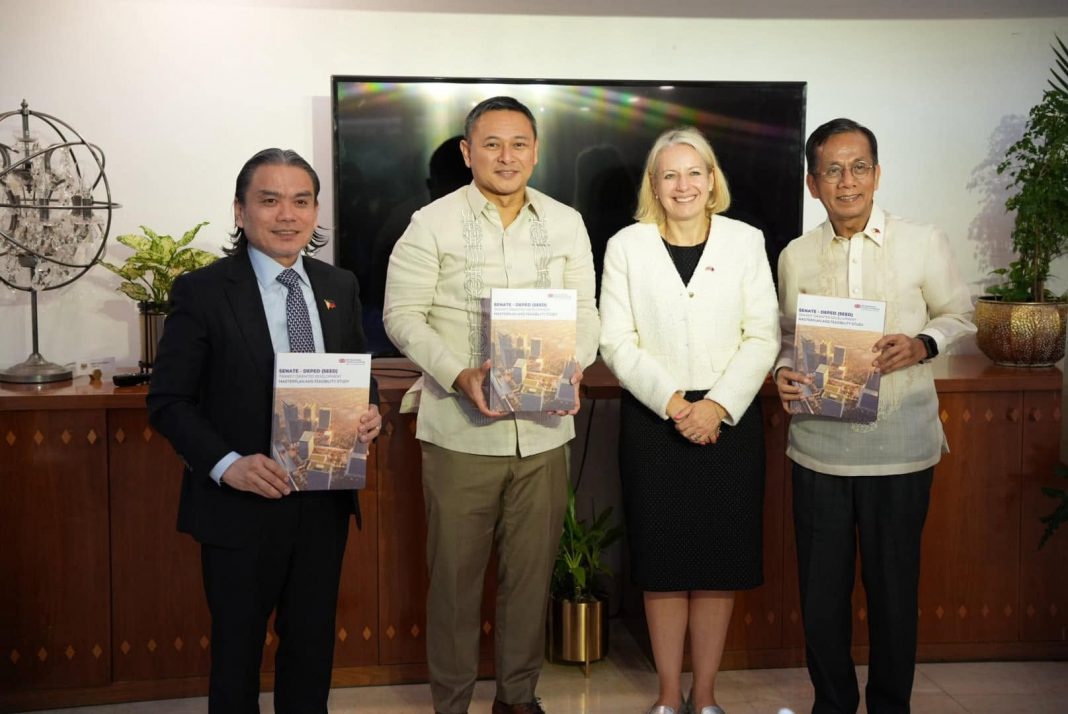
The Department of Transportation (DOTr) and Department of Education (DepEd Philippines), in partnership with the British Embassy Manila, marked a milestone following the turnover of the completed feasibility study for the proposed Senate-DepEd Transit Oriented Development (SEED TOD) Project during the United Kingdom’s Infrastructure Projects Handover and Closing Ceremony held on Tuesday, August 4, 2026.
President Ferdinand Marcos Jr. directed the DOTr to embed transit-oriented development (TOD) principles into major transport infrastructure projects. The initiative seeks to make public transportation more efficient, accessible, and commuter-friendly.
The proposed 13-hectare complex strategically positioned in Taguig City at the junction of the forthcoming North-South Commuter Railway (NSCR) and Metro Manila Subway Project (MMSP) will bring together public transport, government offices, commercial establishments, community facilities, and open spaces.
Transportation Secretary Giovanni Lopez, through a message delivered by DOTr Undersecretary for Planning and Project Development Teodorico Jose Delfin, said commuter-focused and pedestrian-centric policies are central to DOTr’s infrastructure vision.
“The SEED Project exemplifies what this looks like at ground level. In Taguig, a 13-hectare complex will demonstrate how education, residential and commercial spaces can co-exist around transit modes, creating an environment where students spend less time commuting and more time studying, where families have genuine mobility choices and where the city itself becomes more livable and sustainable,” Sec. Lopez said.
Conceived as a transformative campus for education and research, the SEED TOD project is set to host leading institutions while offering approximately 497,663 square meters of gross floor area for commercial, cultural, meetings, incentives, conferences and exhibitions (MICE) and community uses.
Designed with a car-free core, 59% of the site is reserved for publicly accessible pedestrian space, featuring covered walkways and elevated high-walks positioned above 50-year flood levels.
Also, the feasibility study proposes shorter, safer, and easier transfers between the NSCR and MMSP. The transfer route could be reduced from 900 meters to 200 meters, cutting transfer time by around 17 minutes.
Department of Economy, Planning, and Development (DEPDev) Secretary Arsenio Balisacan said that “By strengthening links among rail, bus, walking, and cycling networks, this study has made substantial improvements in connectivity, including shorter interchange times between the two railway systems. The study also identifies prospects for job creation, more efficient use of public assets, and opportunities to leverage public-private partnerships.”
The feasibility study which started in November 2024 was funded by the United Kingdom Government through its Green Cities and Infrastructure Programme. Crossrail International served as masterplanning consultant, while the Public-Private Partnership Center provided technical assistance in structuring the project.
During the ceremony, British Ambassador to the Philippines Sarah Hulton OBE commended the Philippine government for its strong collaboration with the United Kingdom, as the two nations mark 80 years of friendship and diplomatic relations.
“For the UK, these projects align very closely with our broad objective of working in partnership with the Philippines to foster sustainable economic growth through high-quality infrastructure, stronger institutions, and deeper economic partnerships,” Ambassador Hulton OBE said.
Meanwhile, the Department of Education (DepEd) is the project’s major landowner and co-grantor with the DOTr.
Highlighting the project’s benefits for education, DepEd Undersecretary Mel John Versoza read the message of Education Secretary Juan Edgardo “Sonny” Angara.
“It is our commitment to create greener, more livable learning environment by integrating parks, open spaces, and urban greenery into our school communities, especially in highly urbanized areas like Metro Manila where public green spaces remain in short supply.”

