


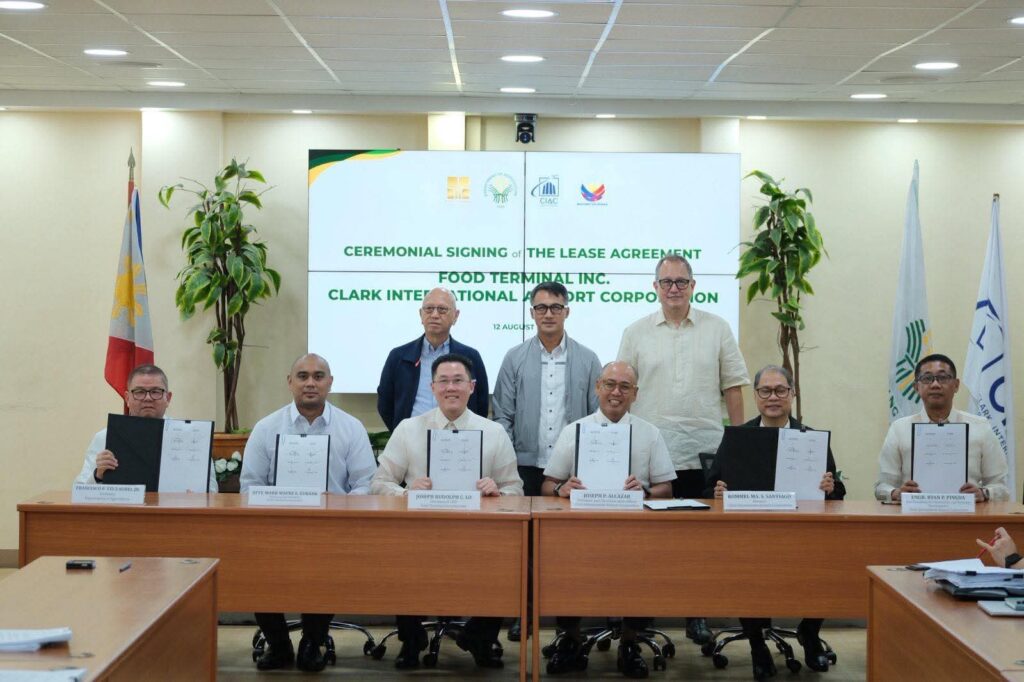
The Department of Agriculture is fast-tracking the Clark National Food Hub with the full backing of President Ferdinand R. Marcos Jr., moving the project from planning to construction.
The project gained formal momentum with the signing of agreements between the DA and Food Terminal Inc. covering funding, development and operations, and between FTI and Clark International Airport Corp. covering around 40 hectares at the Clark Aviation Capital in Pampanga, with provisions for future expansion.
Agriculture Secretary Francisco P. Tiu Laurel Jr. has directed FTI President Joseph Lo and Agriculture Undersecretary Arrey Perez to have the Mega Food Hub partially operational before the end of 2027.
Tiu Laurel cited Perez’s previous experience helping develop New Clark City, including its road network and key buildings delivered ahead of schedule, to help keep the food hub on its accelerated timeline.
The hub will bring together food aggregation, storage, processing, distribution, and marketing in one integrated system. Planned facilities include food and cold-storage facilities, processing areas, food safety laboratories, export processing facilities, and wholesale and retail spaces.
Tiu Laurel said the project is intended to close a critical gap between farm production and markets, where inefficient logistics erode farmers’ earnings, discourage private investments, and increase costs for consumers.
“We cannot build a modern agriculture sector if our farmers can produce more but cannot get their products to markets efficiently and profitably,” Tiu Laurel said. “Today, we give this project the foundation to move from paper to pavement.”
The DA chief said the Mega Food Hub is central to Marcos’s vision of a more modern and food-secure Philippine agriculture sector. “And this is more than just a campaign promise. For President Marcos, it is a covenant with the Filipino people, especially those who feed the nation every day,” he said.
Lo said preparations have been underway since last year, including the recruitment of a dedicated team focused exclusively on designing how the facility will operate. The team has studied food hub models and logistics practices abroad, traveling to Thailand, France, Spain, Netherlands and Japan to examine best practices that could be adapted to the Philippine setting.
FTI will operate, manage, and maintain the facility, with a mandate to make it efficient and sustainable. The DA will oversee project implementation and construction monitoring.
Once fully scaled up, the hub is expected to support about 2,500 jobs and create opportunities across the agriculture and fisheries value chains.
Agriculture Undersecretary Arrey Perez said the hub is ultimately about raising incomes at the farm level.
“Our dream here is simple: to put more money in the pockets of our farmers and fisherfolk. At the Clark Hub, they will have a direct way to sell their harvest to markets and buyers, with less layers in between.
This is not just about buildings and warehouses — it is about building a system that makes life easier and more profitable for those who feed our nation,” Perez said.
The project is ultimately a bet on logistics as a pillar of food security. Producing more food does not automatically make the food system more efficient. Farmers also need reliable storage, processing, transport, and access to buyers.
With P4 billion now committed, the groundwork now in place and the first phase moving toward construction, the government is putting the pieces together.
The real measure of success, however, will be whether the Clark Hub can move food faster, connect producers more directly to markets, and put more income back into the hands of the people who produce it.

