


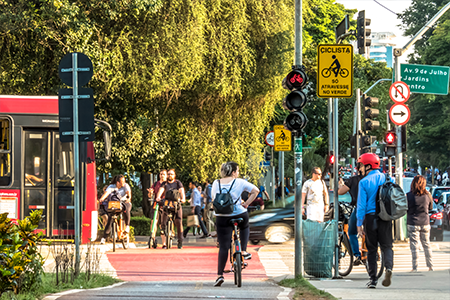
As the global population becomes increasingly urbanized, a new report from the International Transport Forum (ITF) warns that without proactive policy shifts, the expansion of cities and rising transport demand will place significant strain on productivity, the environment, and public safety.
The ITF estimates that by 2060, more than 70% of the global population will reside in urban areas. Projections indicate that if current trends persist, urban travel demand will surge significantly between 2025 and 2060, with an 81% increase in passenger-kilometres and a 69% increase in vehicle-kilometres. This growth is driven by rising incomes, an ongoing shift toward private vehicle ownership, and the spatial expansion of cities.
While this growth reflects global development, it brings mounting negative externalities, including severe congestion that erodes labour productivity, heightened environmental impact, and increased road safety risks.
“The challenge is not simply to accommodate growth, but to reshape how we move within our cities,” the report states. “Urban travel demand management—applying strategies to increase system efficiency by redistributing travel in space and time—is the critical lever for balancing the desire for mobility with the need for liveable, sustainable urban environments.”
Drawing on extensive international case studies, the report provides a roadmap for policymakers to implement effective, long-term solutions. The ITF offers the following core policy recommendations:
-
Adopt Vision-Led Planning: Move beyond reactive measures to a proactive, vision-led approach that integrates demand management into the core of urban planning.
-
Implement a Systems Approach: Ensure policies are coordinated across sectors to improve outcomes and secure public buy-in.
-
Prioritize Equity: Address the distributional impacts of new transport policies from the outset to ensure they remain fair and inclusive.
-
Bridge Land-Use and Transport: Align transport strategy with land-use planning through forward-looking policy reforms to reduce the need for long, car-dependent trips.
-
Expand Sustainable Options: Improve infrastructure and access to walking, cycling, and shared mobility modes.
-
Utilize Data-Driven Frameworks: Enhance appraisal, monitoring, and evaluation to ensure policies are effective and cost-efficient.
-
Leverage Strategic Pricing: Consider vehicle access and pricing mechanisms where appropriate to manage congestion.
-
Foster Public Acceptance: Prioritize transparent communication to build the public support necessary for successful policy intervention.
The report highlights that well-executed demand management is not only a tool for reducing congestion—it is a cost-effective strategy that can provide long-term, sustainable funding for transport infrastructure.
The full report, including detailed case studies and comprehensive implementation strategies, is now available from the International Transport Forum.

