The Association of Licensed Manning Agencies (ALMA), which represents more than 60 maritime agencies deploying approximately 170,000 Filipino seafarers, said its members are complying with the government’s new rules and regulations governing the overseas employment and recruitment of Filipino seafarers as the industry aims to sustain robust business growth.
ALMA President Capt. Antonio “Tony” Ladera III and ALMA Chairperson Atty. Iris Baguilat told LogisticsNews.PH on the sidelines of the association’s Annual General Meeting that the Department of Migrant Workers (DMW) had ensured that the new guidelines were acceptable to both seafarers and their employers and principals.
While the new rules are perceived to place greater emphasis on seafarer welfare, Ladera said, “Overall, it protects the manpower, principals and manning agencies.”
He said the industry has been growing robustly, posting double-digit revenue growth depending on the number of vessels handled by an agency. Even during the COVID-19 pandemic, “We did not stop, we have to sail, and we are still profitable,” he said.
Ladera said supply chain disruptions caused by ongoing conflicts and tariff issues have not significantly affected their operations because shipping companies, as carriers of goods, simply follow the flow of trade.
On seafarer salaries, he said compensation rates generally follow a pattern based on the economic and social standing of the seafarer’s home country.
Ladera is the Philippine president of V.Ships, the world’s largest ship manager, which operates about 600 cargo vessels and deploys around 12,000 Filipino seafarers. He is also president of Open Sea Crewing Agency, the local manning agency for Carnival Cruises. The agency currently supplies about 19,000 workers to 29 cruise ships.
“Business is good,” he said.
He added that trade could be significantly stronger if there were no conflicts affecting the Black Sea and the Middle East.
Compliance
ALMA Chairperson and chair of the ALMA Legal Committee Baguilat said the association considers the new DMW rules manageable. However, she said more information and education campaigns are needed to ensure that all members understand and comply with the new regulations.
Baguilat said the new rules balance the interests of seafarers, manning agencies, and their principals. During discussions of the new DMW rules through the technical working group, she said ALMA ensured that the regulations would protect jobs.
Without seafarers, she pointed out, there would be no manning industry.
For now, manning agencies are in a transition period, but she said, “We don’t see any reduction in business. I hope not result in reduction in revenues.”
Ladera also noted that the 2026 rules have clarified some ambiguities in the previous 2016 regulations.
For instance, the new rules establish different levels of disability to determine a seafarer’s employability, unlike the previous system, which provided only a single remuneration amount.
While there were comments regarding a seafarer’s right to refuse to sail in high-risk areas, compensation during such periods, and redeployment, Ladera said these provisions were patterned after the International Bargaining Forum (IBF). Unlike the IBF framework, however, the DMW rules impose sanctions and require compensation for affected seafarers.
Most disputes, he said, are resolved among the parties involved.
Rules
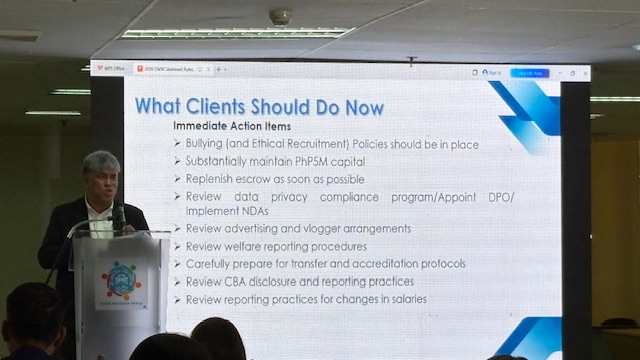
Atty. Joseph Rebano, partner at Del Rosario & Del Rosario Law Offices and a member of the ALMA Legal Committee, presented the salient provisions of the new rules, which he described as moving toward a welfare-oriented regime rather than treating employment strictly as a contractual relationship between the seafarer, manning agency, and principal.
The new rules identify serious offenses that could result in the cancellation of a licensed manning agency’s (LMA) license. These include failure to act on abandonment cases and unreasonable failure to provide assistance or repatriation that results in serious consequences.
For less serious offenses, the rules provide for license suspension ranging from two to six months, and in some cases, up to one year.
These offenses include failure to present employment, payroll, medical, and related records; failure to provide copies of medical records; appointment of agents without notifying the DMW; failure to report cases involving abandonment, terrorism, hijacking, armed robbery, and harassment; failure to notify the next of kin or family; and failure to deploy a seafarer within the validity of an Overseas Filipino Worker (OFW) clearance without a valid reason.
Other offenses include failure to submit reportorial requirements under the Magna Carta of Filipino Seafarers, failure to monitor the status and condition of deployed seafarers, failure to submit quarterly welfare monitoring reports, and other violations involving welfare-monitoring obligations.