


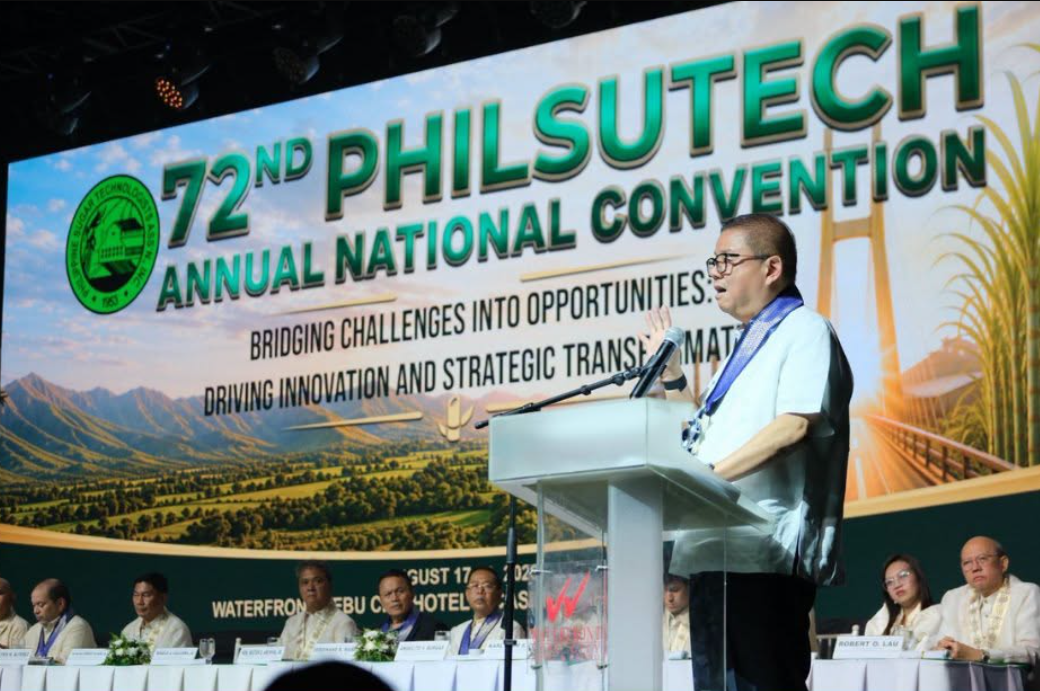
Agriculture Secretary Francisco P. Tiu Laurel Jr. assured the sugar industry that sugar importation is not an administration policy but a tool to stabilize prices and the market.
He said this is the same calibrated approach the government already uses for rice, fish, and staple vegetables, focusing on technology and innovation to build a stronger, more productive, and self-reliant sugar industry.
During the 72nd Philippine Sugar Technologists Association (PhilSuTech) Annual National Convention, Tiu Laurel explained that imports can help fill temporary supply gaps, thus preventing excessive price volatility and protecting consumers while ensuring that domestic producers are not disadvantaged. “Sugar importation is not the policy of this administration. It is a tool for price and market stabilization to be used when necessary and under clearly defined circumstances,” he said.
The Philippines remains a net sugar producer, importing only to fill verified supply gaps. For example, after Typhoon Odette damaged sugarcane fields in Negros during the 2021-2022 period, the country imported 200,000 metric tons (MT) of sugar. The government also approved another 424,000 MT in mid-2025 to address verified supply shortages and establish a buffer stock.
Currently, the sugar import ban also includes an allocation system that links each import permit to a corresponding local purchase. Moreover, performance bonds are required; if these bonds are forfeited, the funds subsidize fertilizers for sugarcane farmers.
Tiu Laurel said the government is further improving the policy for future sugar imports and will present it to the industry for consultation. “In future importations, we will just import just enough for what the country needs. Not more, not less,” Tiu Laurel says.
The approach, he said, is intended to support market stability while giving the domestic industry space to become more competitive. “Our fundamental policy remains clear. We want a Philippine sugar industry that is stronger, more productive, more competitive, and more self-reliant,” he says.
Tiu Laurel also pointed out that the industry is facing serious challenges, including the red-striped soft scale insect (RSSI), high production costs, rising input prices, labor shortages, limited access to technology and financing, and climate change.
Industry representatives have already agreed to form a National RSSI Task Force, to be led by the Department of Agriculture and the Sugar Regulatory Administration, with support from other government agencies, farmer organizations, millers, refiners, distillers, and workers, Tiu Laurel said. “This will unify and consolidate all RSSI-related efforts,” he says, adding that the task force would also ensure that farmers are properly informed about available government programs, as well as the appropriate protocols and practices.
But he urged industry stakeholders to view these problems as opportunities for transformation. “When we see a labor shortage, let us see an opportunity for mechanization. When we see climate risks, let us see an opportunity for climate-smart agriculture. When we see low productivity, let us see an opportunity for science, technology, and yes, a little more innovation than we have had in the past,” he said.
The DA has allocated P300 million for 2027 to develop laboratories or incubation centers in each municipality where sugar is planted, in anticipation of a resurgence of RSSI.
Tiu Laurel said the industry must move beyond simply helping farmers survive difficult seasons. “We have to build an industry that can anticipate problems, adapt quickly, and come out stronger than this,” he said. “Good things take time, but we also know that nothing gets sweetened without hard work,” he added.

