


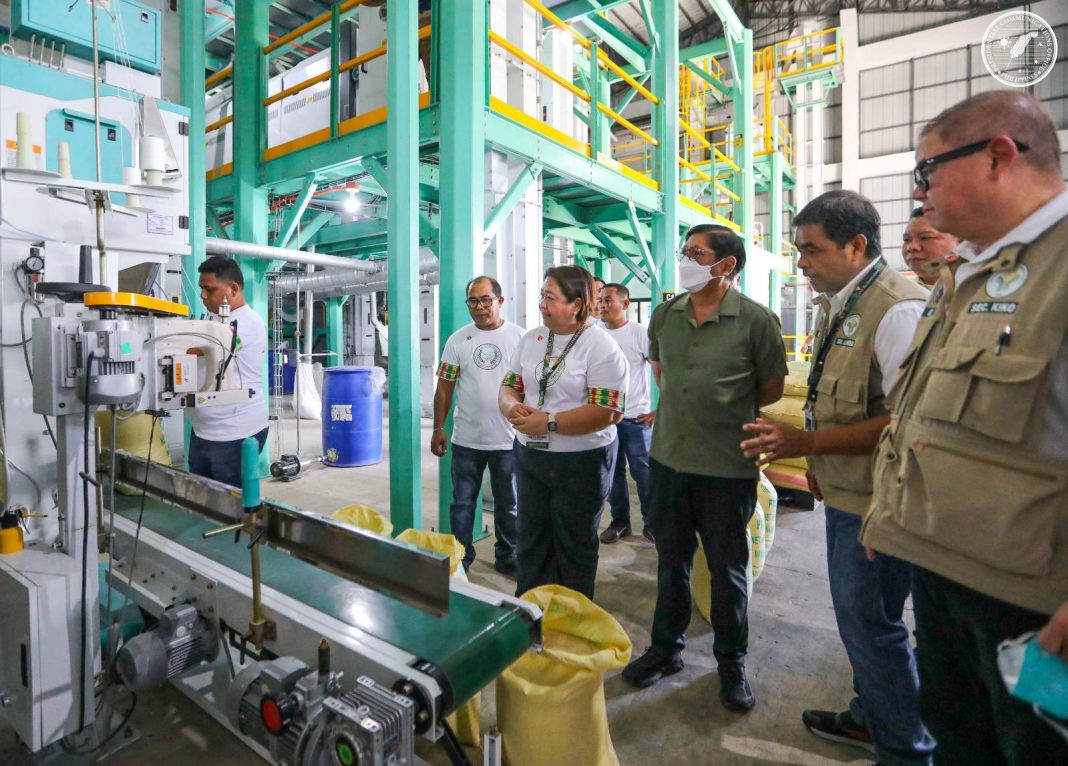
President Ferdinand R. Marcos Jr. announced on Monday a massive expansion of the nation’s post-harvest infrastructure, committing to the establishment of over 300 additional palay processing centers nationwide within the year.
The initiative aims to reduce post-harvest losses drastically, increase the income of local farmers, and ensure a stable national rice supply amid global market volatility.
During an inspection of the newly constructed Rice Processing System (RPS) in Hamtic, Antique, the President emphasized the need to move away from primitive drying methods. He noted that the administration has already completed 152 facilities and is now accelerating the rollout.” This year, we will build over 300 more drying systems,” President Marcos stated. “I told the Secretary of Agriculture Francisco Tiu Laurel Jr. that I no longer want to see palay being dried on roadsides only to be run over by trucks. Our farmers work too hard for their harvests to be wasted like that.”
The expansion of the RPS is part of a broader government mandate to modernize the entire agricultural value chain. The Chief Executive detailed a multi-pronged approach to support the sector:
-
Mechanization: Providing state-of-the-art machinery to increase efficiency.
-
Essential Inputs: Ensuring farmers have access to high-quality seeds and fertilizers.
-
Risk Mitigation: Offering crop insurance to protect livelihoods against natural calamities and climate change.
-
Fisheries Support: Distributing motorized boats and livelihood tools to strengthen the blue economy.
President Marcos underscored that domestic productivity is the ultimate defense against global food shortages. “Whatever happens in the rest of the world regarding rice supply, we must ensure we always have enough for ourselves,” he asserted.
Following the inspection, the President led the ceremonial handover of multi-million peso aid packages, equipment, and financial support to farmers and fisherfolk across the province of Antique.

