


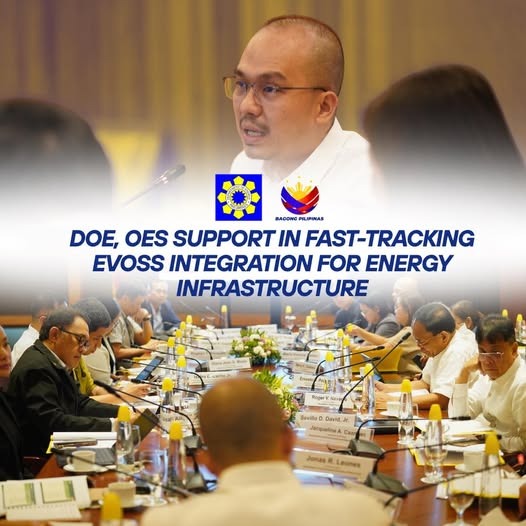
The Department of Energy (DOE), in collaboration with the Office of the Executive Secretary (OES), recently convened the 23rd Energy Virtual One-Stop Shop (EVOSS) Steering Committee Meeting.
During the session, committee members and partner agencies reaffirmed their commitment to the full integration of the EVOSS system, a move designed to drastically reduce bureaucratic hurdles in the Philippine energy sector.
The EVOSS system, established under Republic Act No. 11234, serves as an online platform that streamlines the permitting process for power generation, transmission, and distribution projects. By digitizing and centralizing applications, the government aims to eliminate redundancies and accelerate the transition to a more robust energy landscape.
A central component of the meeting was the status review of 21 “Priority Energy Projects.” These projects are deemed critical for maintaining the stability of the national grid and meeting the country’s growing demand for electricity. The Steering Committee received detailed progress updates from key regulatory and environmental bodies, including:
- Energy Regulatory Commission (ERC): On the alignment of regulatory approvals with project timelines.
- National Grid Corporation of the Philippines (NGCP): Regarding transmission interconnection requirements.
- Department of Environment and Natural Resources (DENR) & Department of Agrarian Reform (DAR): On land use, environmental compliance, and conversion clearances.
- National Water Resources Board (NWRB): Specifically addressing water rights and usage for hydro and cooling systems.
The meeting also served as a forum for identifying emerging challenges in the permitting phase. To address these, the committee discussed several policy updates and streamlining frameworks:
- NEHEMIA Report Integration: Applying the “National Effort for the Harmonization of Efficient Measures of Inter-agency Procedures” to energy-related transactions to ensure a unified approach to reform.
- FPIC Guidelines: Refining the “Free, Prior, and Informed Consent” processes to ensure social responsibility and respect for indigenous communities while preventing undue delays in project commencement.
Strengthening National Coordination “The full integration of EVOSS is not just a technical upgrade; it is a fundamental shift in how we manage our nation’s energy future,” the DOE stated. “Through this engagement, we are strengthening the connective tissue between agencies to ensure that critical infrastructure moves from the drawing board to the power grid without unnecessary delay.”
By optimizing these inter-agency workflows, the DOE and OES aim to improve project timelines significantly, attracting more private sector investment and ensuring the timely delivery of power to Filipino homes and businesses.

