


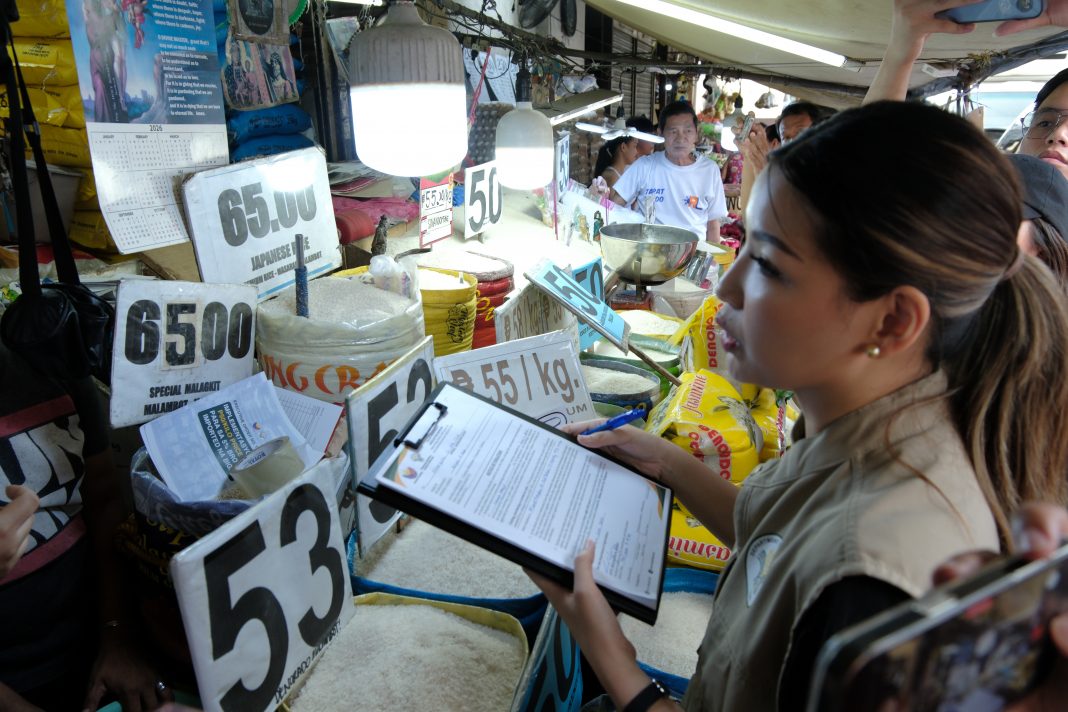
The Department of Agriculture has intensified market inspections across the country as it moves to enforce the P50-per-kilo price ceiling on imported rice with 5 percent broken grains, issuing several notices of violation to retailers found flouting the government order.
Agriculture officials said compliance has steadily improved since the price cap took effect, reflecting heightened monitoring and the growing presence of law enforcement personnel in public markets.
The latest inspections were conducted simultaneously in several Metro Manila markets and other parts of the country, highlighting the government’s determination to ensure that lower global rice prices translate into savings for consumers.
At Dagonoy Market in San Andres, Manila, most rice stalls were closed during the inspection. Market officials told DA personnel that the retailers were attending a summer outing. Police Maj. Gen. Edgar Alan Okubo said police personnel would return later to inspect the closed stalls and submit monitoring reports to the DA.
At Trabajo Market in Sampaloc, Manila, a team led by Assistant Secretary Wiann Angsiy issued a notice of violation to a retailer who replaced a shelf label after inspectors arrived. The stall had initially displayed imported rice priced at P55 per kilo, above the mandated ceiling.
At Alabang Central Public Market, Undersecretary Cheryl Marie Natividad-Caballero and Assistant Secretary Arnel de Mesa also issued notice of violation for a retailer selling imported premium rice at P60 per kilo and to several retailers for mislabelling local rice as imported rice.
Some retailers have complained that the price cap could leave them with little or no profit because certain suppliers allegedly sell imported rice at prices that leave insufficient room for retail markups. Angsiy said retailers making such claims would need to disclose their sources of supply so authorities could investigate upstream players in the rice trade.
“If retailers are saying they cannot earn because of the prices imposed by suppliers, they have to identify those suppliers so we can go after the importers or wholesalers who may selling way above the acceptable prices,” she said.
Angsiy also said another retailer was suspected of mislabeling imported rice as locally produced rice, a practice that could allow sellers to command higher prices. However, she noted that formal sanctions would depend on laboratory tests by the Bureau of Plant Industry on samples collected from the market.
“As long as this price cap is in effect, we will continue conducting surprise inspections across markets nationwide,” Angsiy said.
DA enforcement teams likewise issued notices of violation to rice retailers found to be non-compliant with Executive Order No. 118. Of the 36 notices issued, 19 were recorded in Region I (Ilocos Region), 8 in the National Capital Region, 4 in Region III (Central Luzon), 3 in the Negros Island Region, and 2 in Region V (Bicol Region).
Based on reports submitted by the regional field offices, the nationwide compliance rate reached 47.42 percent during the latest round of nationwide simultaneous market visits. The issuance of notices of violations forms part of the DA’s intensified monitoring and enforcement efforts to ensure adherence to government-mandated rice cap policies and protect consumers from unjustified price increases.
The DA emphasized that these aggressive enforcement measures support the government’s broader strategy to curb food inflation and improve access to affordable rice, which remains a staple commodity and one of the largest household expenditures for millions of Filipino families.
Officials believe sustained compliance will help keep rice affordable, but the complaints from retailers also highlight the challenge of enforcing price controls across a supply chain that extends far beyond public markets.

