


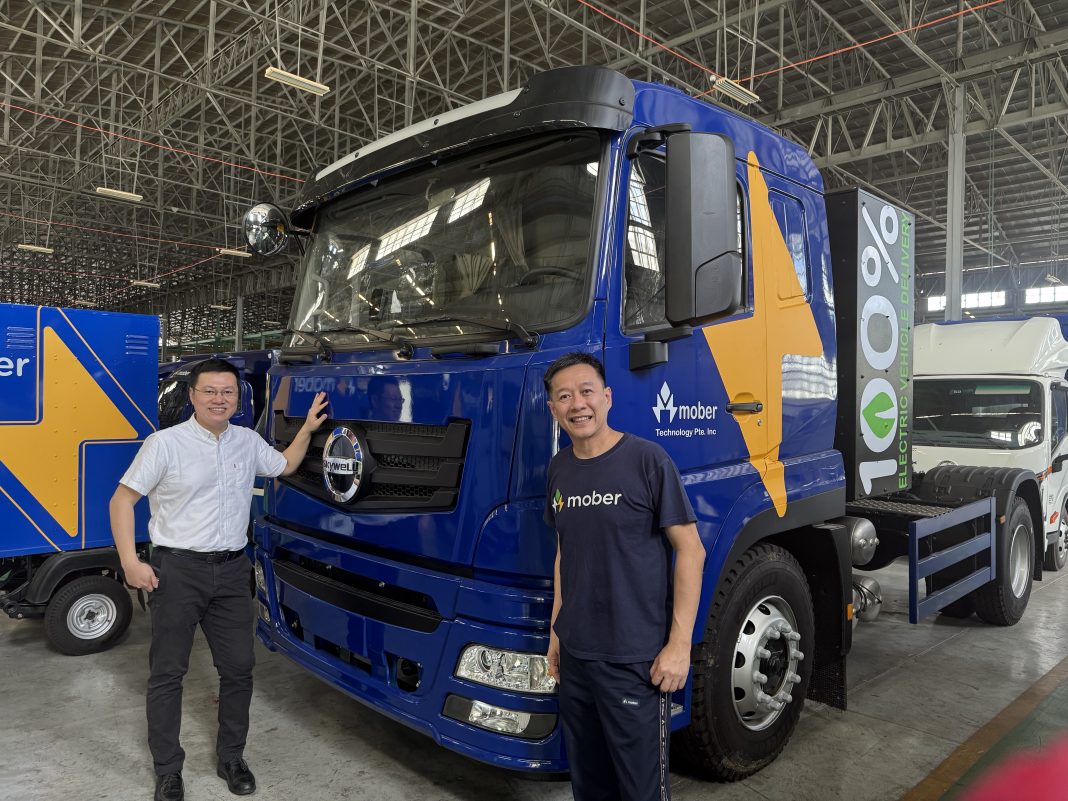
Mober, the country’s pioneer in green logistics, is expanding its operations into container delivery through the planned acquisition of 10 fully electric tractor head trucks this year.
Company Founder and CEO Dennis Ng told Logistics News PH that Mober is scaling up its pioneering green mobility venture from light trucks and vans to heavy-duty trucks to meet the growing demand for container deliveries.
Mober launched last year its container delivery service with the acquisition of the country’s first fully electric tractor head truck, capable of hauling 39-ton payload. Ten more tractor head trucks are expected to be delivered this year, also from China. The new electric tractor head truck offers a range of up to 220 kilometers on a single charge from its 282.6-kilowatt-hour battery.
Alongside its expansion into container logistics, Mober is also strengthening its charging infrastructure across Southern Luzon. The company currently operates an exclusive charging facility in Pasay and has installed charging systems at several client facilities.
Mober began operations in 2015 as a conventional logistics provider using traditional delivery vans. Its transition to green logistics came after client IKEA challenged the company to adopt a more sustainable approach. Mober embraced the challenge and eventually converted its fleet to fully electric delivery vans.
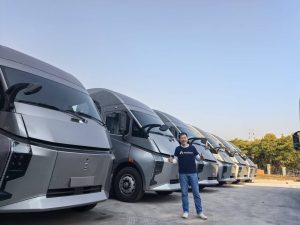
Today, Mober serves at least 10 blue-chip clients, including Nestlé and Starbucks. The company has also expanded to Thailand to support IKEA’s logistics requirements.
One of the key challenges facing logistics companies that want to transition to electric vehicles is financing, according to Ng.
“Not all banks are willing to finance commercial EVs because of the residual value issue of the vehicle since EVs are still very new in the market,” he said.
However, Ng believes banks should have greater confidence in financing commercial EVs because these vehicles generate revenue for businesses.
He explained that delivery trucks are constantly on the road and earning income, helping ensure loan repayments. This contrasts with personal EVs, which do not directly generate revenue. He also noted the rising number of repossessed personal vehicles due to unpaid loans.
Despite the limited appetite among banks to finance electric trucks, Ng expressed appreciation for the support provided by BDO Unibank.
“I think we have 70 units of electric vans with them,” he said. Mober currently operates approximately 130 electric vans serving its growing client base. “They (BDO) really invest in EV financing,” he said.
The company has also invested in a proprietary Battery Management System (BMS), enabling it to monitor battery performance and collect critical data on what is often the most expensive component of an electric vehicle. Through the BMS, Mober is able to maximize the lifespan and efficiency of its EV fleet.
“Our first EV was a van, that was 2021. And it is still fine, with battery degradation rate at around 95 to 96 percent. I think all EV batteries are being warranted with 8 years,” he said.
To ensure proper vehicle maintenance and efficient operation, Ng said the company established the Mober Driver Academy to train drivers in EV-specific driving techniques.
“We teach our drivers proper EV braking, when you do soft braking, it charges the battery back, it generates new power,” he said.
Ng also dismissed concerns about range anxiety for electric delivery vehicles, noting that drivers know their routes and delivery destinations in advance. Mober’s average delivery distance is approximately 120 to 130 kilometers, which can be comfortably covered on a single charge.

