


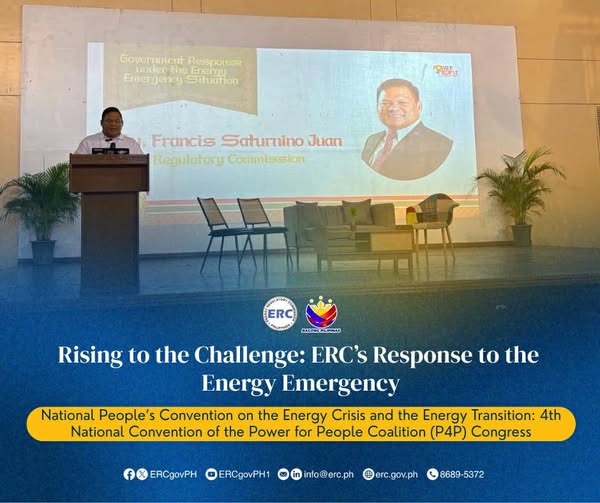
Energy Regulatory Commission (ERC) Commissioner Francis Saturnino Juan delivered a candid address yesterday to the Power for People Coalition (P4P) during its 4th National Convention, confronting the ongoing energy crisis and laying out the regulatory body’s immediate and long-term response strategies.
Speaking to a crowded congress at the National People’s Convention on the Energy Crisis and the Energy Transition, Commissioner Juan bypassed standard technical jargon to directly address the financial strain gripping Filipino consumers.
“The electricity bill arrives. You open it. You’re shocked,” Juan said, acknowledging the public’s frustration. “You have the right to know why electricity bills are so expensive — and what the government is doing to change that. We promise you three things: we will be honest about the reasons for the high costs; we will be quick to respond to the crisis; and we will be strong in changing the structure of our energy sector.”
Commissioner Juan highlighted that the Philippines currently endures the third-highest electricity prices in Asia, trailing only Japan and Singapore. He outlined four structural drivers behind these steep rates:
-
Geographic Fragmentation: The archipelago’s split into three distinct, minimally integrated power grids (Luzon, Visayas, and Mindanao) requires each grid to maintain its own independent reserve capacities and infrastructure, driving up baseline operational costs.
-
Imported Fuel and Currency Depreciation: A heavy reliance on imported coal, natural gas, and oil leaves the sector vulnerable to foreign exchange fluctuations. With the Philippine Peso depreciating from around ₱45 per dollar in 2015 to ₱62 today, fuel costs have ballooned. Furthermore, domestic energy bills lack state subsidies, passing the full weight of these costs directly to consumers.
-
Aggressive Taxation: Unlike ASEAN neighbors that offer exemptions, the Philippines applies a full 12% VAT under the TRAIN Law across all bill components (generation, transmission, distribution, and supply). Universal charges, including local taxes and the amortization of outstanding National Power Corporation debts, further pad the consumer’s burden.
-
High Risk Premium for Capital: Due to perceived regulatory and political risks, lengthy permitting processes, and right-of-way disputes, investors demand higher returns. This risk premium is directly embedded into consumer tariffs.
Juan clarified that while the ERC directly regulates transmission and distribution charges—which make up roughly 20% of the consumer bill—the remaining 60% is dictated by the market-driven generation charge. “However, that is not a reason for us not to act,” Juan emphasized. “It is just a clarification of the problem — so that we can find the right solution.”
Detailing the ERC’s swift interventions since the crisis intensified in March 2026, Commissioner Juan shared key regulatory actions aimed at protecting household budgets:
-
Market Suspensions and Price Pegs: On March 26, 2026, the ERC suspended the Wholesale Electricity Spot Market (WESM) operations across Luzon, Visayas, and Mindanao. The commission implemented a Modified Administered Pricing scheme, capping coal plants at ₱6,000 per megawatt-hour and prioritizing renewable energy dispatch. ERC simulations revealed this intervention successfully averted market spikes that would have otherwise pushed prices past ₱9 per kilowatt-hour.
-
Real-Time Grid Monitoring: The ERC has instituted around-the-clock, hourly tracking across all three main power grids to closely monitor operating margins and preempt volatile WESM price movements.
-
Fast-Tracking Renewable Energy: To insulate consumers from volatile fossil fuel markets and currency devaluation, the ERC has accelerated approvals for Power Supply Agreements (PSAs) and the issuance of Certificates of Compliance, explicitly prioritizing renewable energy infrastructure.
Commissioner Juan closed his address by reaffirming the regulatory body’s commitment to standing with consumers and aggressively pursuing structural changes to transition the Philippines toward a more affordable, self-sufficient energy future.

