


The Philippines has officially entered the World Bank’s Upper-Middle Income Country (UMIC) category, marking a historic economic milestone driven by sustained growth, sound macroeconomic management, and long-term structural reforms, the Department of Economy, Planning, and Development (DEPDev) said.
The World Bank confirmed the upgrade in its latest income assessment on Wednesday (July 1), reporting the Philippines’ gross national income (GNI) per capita as $4,850, exceeding the $4,636 UMIC threshold.
The shift was underpinned by steady economic expansion, with Gross Domestic Product (GDP) growing by an average of 5.8 percent from 2021 to 2025. Strong performance across all industries raised GNI per capita by 8.5 percent in 2025, lifting the Philippines from the lower-middle into the upper-middle income category.
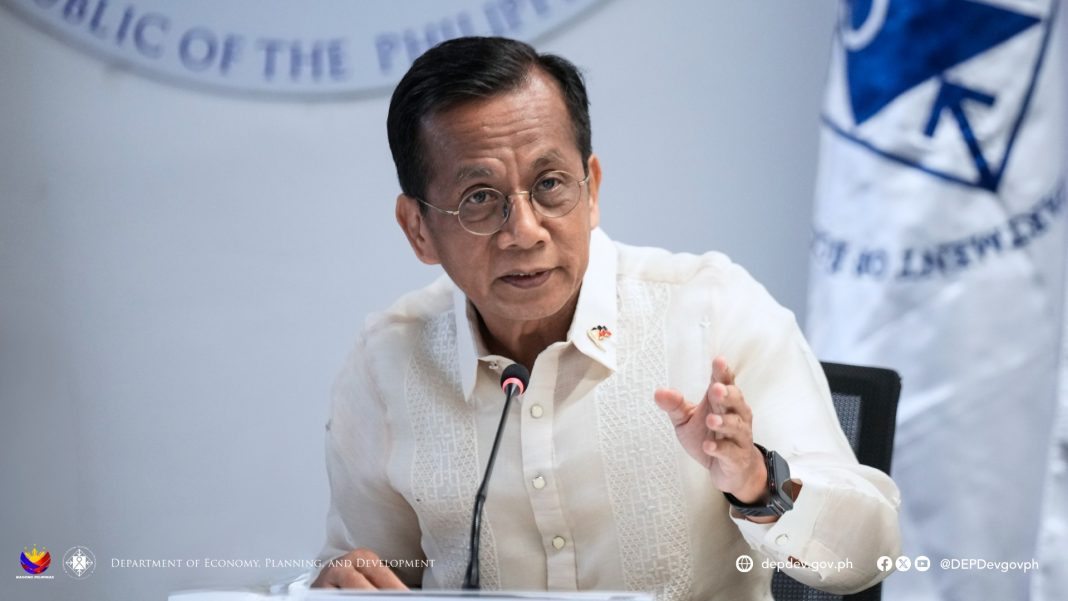
“This confirms the resilience of the Philippine economy,” said DEPDev Secretary Arsenio M. Balisacan. “Despite global and domestic shocks, we have relentlessly pursued inclusive growth, strengthened fundamentals, and remained on track with our development agenda.”
The new classification is expected to strengthen the country’s credit profile, boost investor confidence, and expand access to financing and higher-quality investments that generate better jobs for Filipinos.
While some concessional Official Development Assistance (ODA) may decline over time, the Chief Economist stressed that the gains from stronger fundamentals and improved market access are expected to outweigh these adjustments.
“We welcome this recognition of our progress and we commit to deepen reforms to sustain our economic development,” Balisacan said.
He also acknowledged the contribution of overseas Filipino workers (OFWs), whose earnings abroad form part of the country’s GNI.
“Our OFWs have played an important role in reaching this milestone. At the same time, our long-term goal is to create more high-quality jobs at home so overseas employment becomes a choice, not a necessity.”
Balisacan emphasized that the new classification does not diminish ongoing challenges.
“We acknowledge that income disparities persist, and many continue to face economic difficulties. Our priority is to ensure that growth becomes more inclusive, and that its benefits reach all Filipinos,” Balisacan explained.
The achievement comes as the Philippines serves as ASEAN Chair for 2026, providing the country with an important platform to showcase its economic progress, strengthen regional partnerships, and attract investments that support long-term growth and development.
Meantime, Finance Secretary Frederick Go said the Philippines’ transition to an upper middle-income country is an affirmation of the reforms and policies that the government has consistently pursued to strengthen our economic fundamentals and create more opportunities for our people. “Now, we must continue to build on these gains so that the benefits of economic development reach more Filipinos,” Go said.

