


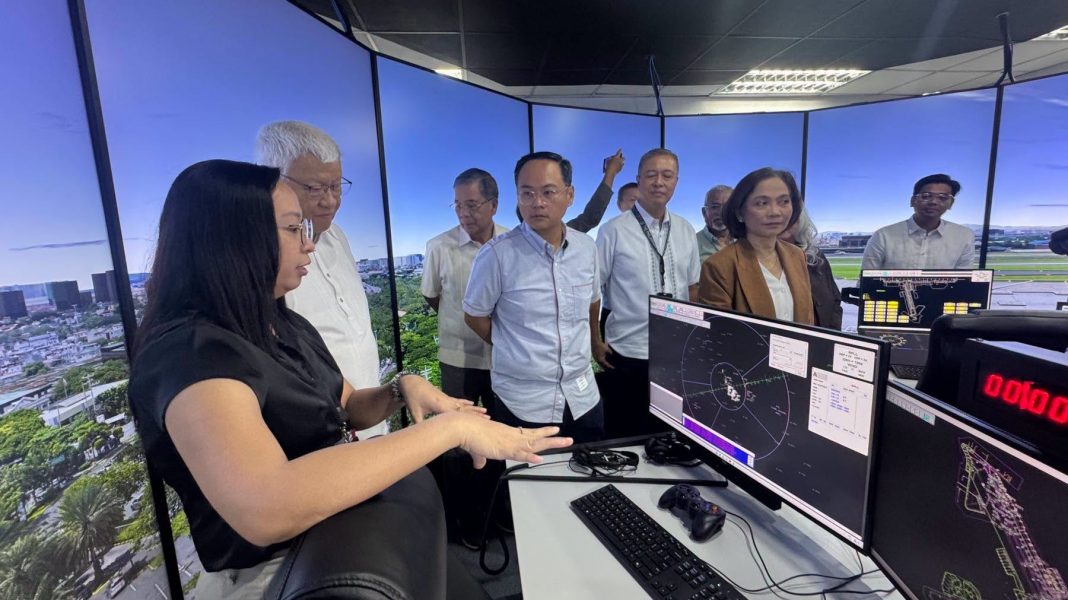
The Civil Aviation Authority of the Philippines (CAAP) inaugurated today, July 23, 2026, the PHP253-million state-of-the-art air traffic control simulators that will provide the best training for air traffic personnel, benefiting and ensuring safety of the entire Philippine aviation industry in the country.
The facility involves three new state-of-the-art, 360-degree simulators namely the Aerodrome, Approach and Enroute simulators.
Transportation Secretary Banoy Lopez said President Ferdinand Marcos Jr. has ordered the Department of Transportation (DOTr) to modernize aviation facilities and equipment, and upskill aviation personnel to ensure foremost the safety of the passengers.
Secretary Lopez emphasized that it is not enough to have modern runways and terminals, but equally important is a modern air traffic control systems to ensure safety for all.
Aside from providing training to CAAP personnel, the CAAP air traffic controller program also provides free specialized air traffic training to students, with guaranteed employment for aspiring Air Traffic Management Officers (ATMOs) who pass their qualifying exams at airports nationwide.
CAAP Director General Raul Del Rosario noted that with the new equipment, the program will be shortened from 9 months to six months of training.
DG Del Rosario added that it will cover aviation safety, air traffic controller (ATC) personnel shortage suffering from fatigue at regional airports and personnel exodus leaving for lucrative jobs overseas.
He said the new facility is a dream-come true for CAAP’s Air Traffic Service (ATS) to have top-of-the line simulators.
The CAAP-ATS is designed to replicate the different phases of an aircraft’s flight and is equipped with the systems, tools and operational features used in actual air traffic control environments, allowing trainees to experience realistic operational scenarios in a controlled setting.
Aviation personnel are expected to benefit from the facility as the simulators will strengthen the Comprehensive Air Traffic Service (CATS) Training Program through highly realistic, scenario-based simulation training.
With the new simulators, air traffic controller competencies including situational awareness, sound decision-making, effective coordination, precise communication, and the management of complex traffic situations will also be developed.
The simulators will likewise reduce reliance on live operational traffic as the primary training environment, providing a safer and more structured transition from classroom instruction to actual operations.
The aviation authority’s upgraded training systems are aligned with the International Civil Aviation Organization (ICAO) Standards and Recommended Practices (SARPs), particularly in the area of Competency-Based Training and Assessment (CBTA).

