


The Philippine commercial real estate (CRE) investments aspire for smart building technology, but cost pressures determine portfolio execution, according to a new study by JLL Global REMS Research of leading property consultancy and management firm JLL.
The “Future of Work Survey” in June this year had over 2,200 respondents, including 100 from the Philippines. From the results, JLL carved a Philippine report “AI-driven CRE investment: Philippines’ distinctive path to CRE Transformation.” The study complements JLL’s Metro Manila Real Estate Overview, focusing on office and retail space scenario where vacancy rate still remains within 18 percent amid weak demand and continued supply of work spaces.
The overall global study, highlighted three results: the AI execution barrier, the capability gap, aspiration-affordability disconnect.
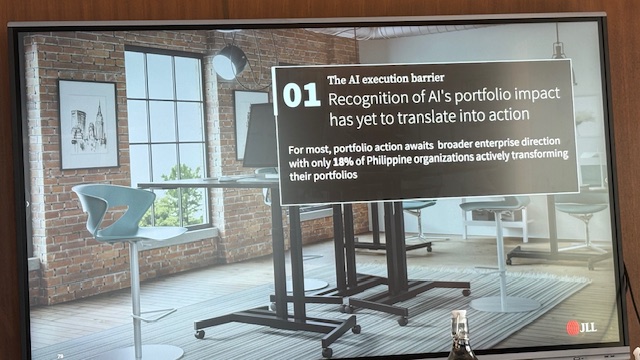
On the AI execution barrier, the report showed that 79 percent of firms in the Philippines recognize the need for portfolio action, but only 18 percent are actually transforming.
This is also similar with the global results which showed 78 percent acknowledging the need for portfolio action in response to AI-driven transformation but only 15 percent are actively transforming, said Janlo de los Reyes, head of research and strategic consulting at JLL Philippines.
At the building level, 76 percent of Philippine organizations prioritize long term commercial real estate (CRE) transformation and 66 percent driven buildings, despite automation cost challenges.
The Philippines, however, anticipate growth in the use of AI in the workplaces. Three in four Philippine organizations expect headcount growth, but AI simultaneously creates talent scarcity.
In terms of capability of its workforce, the study showed that the Philippines top three AI adoption constraints include skills gaps, organizational silos, and regulatory complexity.
Globally, the study showed that skills gaps in AI and emerging technologies emerge as the number one barrier to CRE transformation, overtaking budget constraints as the primary concern for the first time in the survey’s 15-year history.
In addition, the study said that Philippines confront economic volatility and budget pressures as top risks, while global trends focus on technology-associated risk.

