


The country’s largest business organization, the Philippine Chamber of Commerce and Industry (PCCI), categorically declared that Filipino companies want to be part of Pax Silica, a US-led initiative that seeks to establish an AI Acceleration Hub in New Clark City (NCC).
“We want to be part of that development,” declared PCCI President Ferdinand “Perry” Ferrer during the organization’s 3rd General Membership Meeting in Makati on Wednesday.
Amid the dissent from various groups against Pax Silica, Ferrer defended the initiative, whose framework is slated to be signed this year by 23 participants, saying it would benefit not only large corporations but also micro, small, and medium enterprises (MSMEs) and the country as a whole.
For instance, he said there will be no mining operations in Clark, but there will be high-value manufacturing and processing of the nickel ore produced in the country, rather than exporting these critical minerals as raw materials and importing them back as finished products at higher prices.
“We will not be mining, we will be processing,” he emphasized.
With Indonesia already banning the export of nickel, Ferrer said the Philippines should now become the world’s largest exporter of these critical minerals. For instance, copper is used in various applications for electric vehicles and in the electronics and semiconductor industries.
“Instead of exporting them, why not process them here?” he said.
In fact, he said some of the nickel used in Tesla’s EV batteries may have come from the Philippines.
Ferrer, who is president of the major electronics firm EMS Group, said the Philippine electronics and semiconductor industry is largely engaged in testing and assembly, the final stage of the electronics manufacturing process and the segment that generates the least value added.
But with Pax Silica, he said, at least one major company has expressed interest in investing in wafer fabrication, the most important and capital-intensive segment of semiconductor manufacturing.
The absence of a wafer fabrication facility has prevented the local electronics and semiconductor sector from moving up the value chain.
Wafer fabrication is the core operation in semiconductor manufacturing. It transforms a plain silicon wafer into a complex grid of active electrical circuits through hundreds of precise, repetitive steps.
Investments, jobs
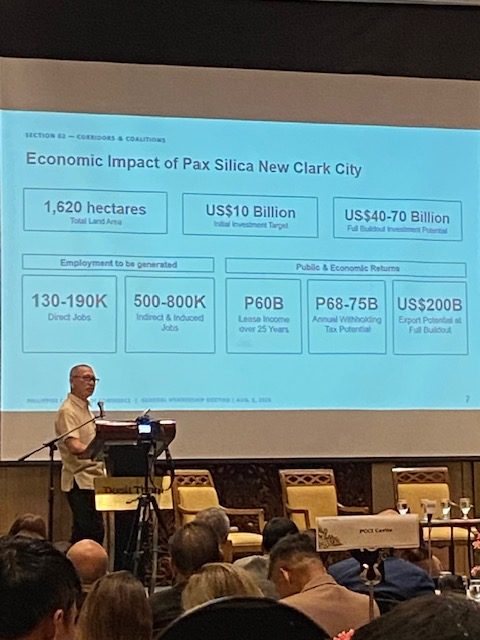
Initial investments in Pax Silica, which will be situated on a 1,620-hectare site in New Clark City, are estimated at USD10 billion, with the potential to reach USD40 billion to USD70 billion once fully developed. Ferrer said investments could eventually exceed USD100 billion over time.
Export potential is estimated at USD200 billion once the project is fully built, with an annual withholding tax potential of PHP68 billion to PHP75 billion and lease income of PHP60 billion over 25 years.
These investments are also expected to create 800,000 indirect jobs across various support industries, such as logistics, hotels, and micro, small, and medium enterprises. Direct employment is estimated at between 130,000 and 190,000 jobs.
Benchwarmer
“The Philippines, for decades, have been waiting as a bystander, but not anymore. With our Pax Silica we will now be a player,” he said.
He likened the country’s future to a basketball game, saying the Philippines had long been part of the team but was not actively playing.
“We are no longer a benchwarmer, we will now be first five,” he said.
“It is up to us Filipinos if we want this or not. But the stage is set, the countries are interested. Are we going to be benchwarmers again and let other countries do it?”

