
The long-overdue Joint Administrative Order (JAO), which is now being finalized for implementation, seeks to set a 75 percent benchmark for container yard utilization that would trigger the implementation of decongestion measures and strengthen the role of the Bureau of Customs (BOC) in regulating charges imposed by international shipping lines, container yards, and service providers.
As the JAO moves toward finalization, the Philippine Chamber of Commerce and Industry (PCCI), the country’s largest business organization, called for its immediate signing by the Department of Finance (DOF), Department of Trade and Industry (DTI), and Department of Transportation (DOTr), with the BOC as the lead implementing agency.

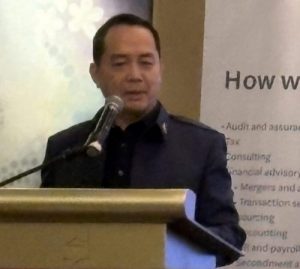
(Photo credit: PCCI Photo)
PCCI President Perry L. Ferrer emphasized the urgency of the measure, noting that excessive logistics costs have long eroded the competitiveness of Philippine enterprises.
“The JAO is a long-overdue solution to the excessive and non-transparent fees that have burdened our industries for years. We urge the Department of Finance (DOF), Department of Transportation (DOTr), Department of Trade and Industry (DTI), the Bureau of Customs (BOC), and the other concerned agencies to finalize and sign the order without further delay. Every day of delay prolongs the burden on businesses and consumers,” Ferrer said.
Among its key provisions, the draft JAO is expected to set a 75 percent yard utilization threshold to guide the implementation of decongestion measures aimed at improving port efficiency, while the determination of a permanent benchmark is still pending.
The JAO will also require shipping lines and other covered entities to report all applicable charges to the BOC. The agency will standardize the nomenclature of logistics fees and oversee the regulation of allowable charges and fee limits under the framework.
The order also mandates the refund of container deposits within 15 days of the return of containers and prohibits shipping lines from withholding cargo over unpaid charges arising from separate transactions.
The draft JAO has completed its public consultation process and is now undergoing final review by the concerned government agencies. It directly addresses long-standing industry concerns over logistics costs, ancillary charges, and port congestion.
The current draft builds on earlier proposals to strengthen oversight of international shipping practices. The BOC is advancing the measure as part of broader efforts to modernize customs administration, improve transparency, and reduce trade bottlenecks. The government is targeting its issuance ahead of the seasonal increase in cargo volumes later this year.
Ferrer expressed full confidence in the BOC’s capacity to lead the implementation of the new regulatory framework, citing the agency’s continuing reforms under Commissioner Ariel F. Nepomuceno.
“Commissioner Nepomuceno’s reforms have helped foster a more transparent, predictable, and rules-based trading environment. We believe the Bureau of Customs is well-positioned to lead the implementation of this important reform, working closely with the other partner agencies,” Ferrer added.
For decades, Philippine enterprises have grappled with high logistics costs, non-transparent ancillary charges, and recurring port congestion—persistent constraints that have undermined the country’s trade competitiveness, increased the cost of doing business, and ultimately burdened Filipino consumers.
The JAO was drafted during the previous administration but was not implemented because then-Finance Secretary Carlos “Sonny” Dominguez did not sign the joint order.
PCCI Vice President for Industry Bryan L. Ang echoed the call, highlighting the tangible benefits the JAO would bring to Filipino businesses and households.
“By addressing excessive logistics costs and promoting greater transparency and accountability across the supply chain, this JAO responds to long-standing concerns raised by the business community. Its effective implementation will help businesses operate more competitively while ultimately benefiting consumers through more efficient and transparent logistics services,” Ang said.
Ang noted that over the years, the proliferation of numerous ancillary shipping charges has significantly increased the cost of importing goods, with some importers reporting logistics costs rising from around PHP30,000 to well over PHP100,000 per container.
“These additional costs are ultimately passed on to Filipino consumers through higher prices. The JAO is a critical step toward ensuring that logistics charges remain fair, transparent, and justifiable while strengthening the competitiveness of Philippine trade,” Ang explained.