


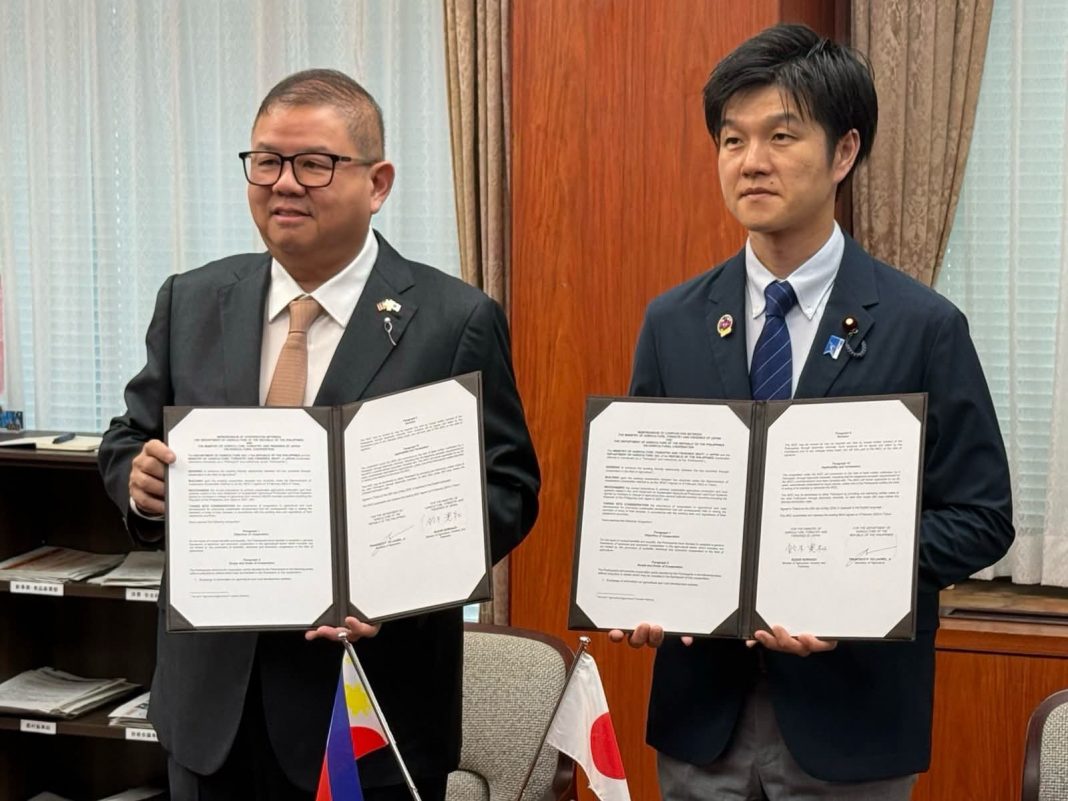
The Philippines and Japan have broadened their agricultural partnership to include fisheries, a move expected to accelerate technology transfer, strengthen food security, and support the modernization of two sectors critical to millions of livelihoods.
The enhanced Memorandum of Cooperation (MOC), signed during President Ferdinand R. Marcos Jr.’s state visit to Japan, upgrades a 2023 agriculture agreement between the Philippine Department of Agriculture (DA) and Japan’s Ministry of Agriculture, Forestry and Fisheries (MAFF).
The new pact comes as the Philippines seeks to raise farm and fishery productivity amid climate risks, rising production costs, and growing food demand.
Agriculture Secretary Francisco P. Tiu Laurel Jr., who signed the agreement with Japanese Agriculture Minister Norikazu Suzuki, said expanding the partnership reflects the growing importance of fisheries in the country’s food security and job creation agenda.
“Food security is not just about producing more crops. It is about building resilient food systems from farms to fishing grounds, embracing technology, and ensuring our farmers and fisherfolk can remain productive despite growing challenges,” Tiu Laurel said.
The agreement elevates cooperation beyond traditional agricultural exchanges, covering smart farming, digital transformation, mechanization, biotechnology, climate resilience, fisheries development, value-chain enhancement, and pest and disease management.
The inclusion of fisheries is particularly significant for the Philippines. The sector contributes substantially to domestic food supply and employment but faces mounting pressures from climate change, resource depletion, and rising operational costs.
Tokyo-based Agriculture Attache Aleli Maghirang said innovation will be a central pillar of the expanded partnership.
“The new MOC also includes the promotion of innovation, including smart technology and digital transformation, for improving productivity in the Philippine agriculture and food systems,” she said.
The agreement will also establish a Joint Committee on Agriculture and Fisheries (JCAF), replacing the previous agriculture-focused mechanism and creating a broader platform for policy discussions, technical cooperation, and project development.
To immediately operationalize the MOC, the Philippines-Japan JCAF meeting is set on July 2-3 2026, iwith MAFF as host in Tokyo.
The partnership could help the Philippines gain greater access to Japanese expertise in precision agriculture, fisheries management, post-harvest technologies, and food systems modernization at a time when boosting productivity has become increasingly urgent.
As the Philippines and Japan celebrate 70 years of normalization of diplomatic relations, the new accord signals a shift toward deeper collaboration on one of the region’s most pressing challenges of producing more food with fewer resources in an era of climate uncertainty.

