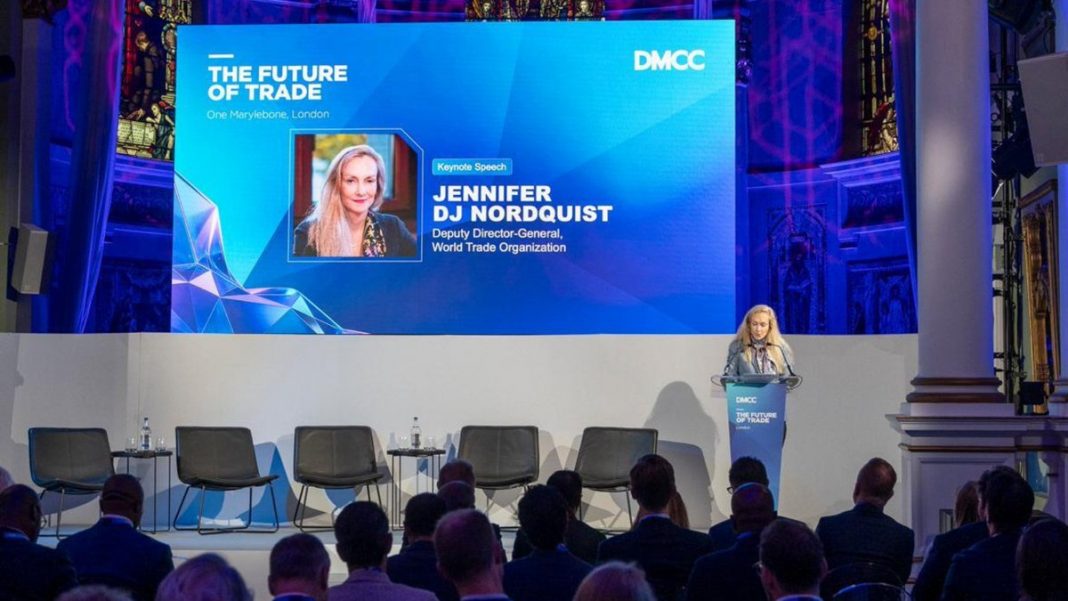
Speaking at the launch of the Future of Trade report hosted by the Dubai Multi Commodities Centre (DMCC) and Asia House, World Trade Organization (WTO) Deputy Director-General DJ Nordquist strongly countered narratives of the WTO’s decline, pointing to resilient global trade data and the crucial, unsung role of the organization’s day-to-day operations.
Addressing an audience of business leaders and policymakers, DDG Nordquist referenced Mark Twain to emphasize that “reports of the WTO’s demise have been greatly exaggerated.” She noted that despite widespread headlines focused on fragmentation, de-risking, and trade frictions, global commerce has demonstrated unexpected strength.
“Global trade in goods and services expanded by approximately 4.7% in 2025, significantly above the rate of global economic growth of 2.9%—almost double—and a significantly better performance than even our own economists had predicted,” Nordquist revealed.
While WTO economists project a moderation in merchandise trade growth to 1.9% for 2026, a rebound to 2.6% is anticipated in 2027. Nordquist highlighted that approximately 72% of global merchandise trade continues to take place on Most-Favored-Nation (MFN) terms under WTO rules, proving that the organization remains the definitive baseline for international commerce.
Nordquist emphasized that while major negotiations and disputes capture public attention, the WTO’s greatest value to the private sector lies in its regular committees, which she labeled the “unsung heroes of the multilateral trading system.”
According to WTO data, members bring hundreds of specific trade concerns to these committees every year—covering technical regulations, standards, and customs procedures—and roughly half of these issues are successfully resolved through routine diplomatic discussion. “Every concern resolved through discussion is a potential disruption avoided,” Nordquist stated, emphasizing the immense economic value of structural predictability for complex modern supply chains.
The speech also highlighted the WTO’s active, data-driven approach to ongoing global economic shocks. In response to shifting geopolitical dynamics in and around the Strait of Hormuz, Nordquist shared that the WTO is utilizing a dedicated dashboard combining live vessel-tracking data with cross-commodity cargo intelligence to monitor trade flows daily.
Crucially, the data reveals a positive trend in government behavior compared to previous shocks like the COVID-19 pandemic and the war in Ukraine. Of the roughly 78 trade measures introduced globally in response to the Strait of Hormuz disruptions, approximately 70% have actually facilitated trade—including steps to streamline customs for energy and food supplies and ease export restrictions—rather than restricting it.
Acknowledging that the WTO’s rulebook has lagged behind the rapid pace of technological innovation since 1995, Nordquist candidly addressed the ongoing necessity for institutional reform.
While the recent Ministerial Conference faced hurdles—including the formal adoption of the Yaoundé Package and the lapse of the e-commerce moratorium—Nordquist reassured the business community that historical precedents show the WTO is highly capable of bridging gaps during continuous negotiations in Geneva. She pointed to the provisional application of the 66-Member E-Commerce Agreement and a 23-member commitment to refrain from imposing digital customs duties as living proof of the system’s adaptability through plurilateral approaches.
“The questions will change, but the need for cooperation will not,” Nordquist concluded. “The WTO remains the foundation for most international trade, a source of transparency during periods of uncertainty, and an institution in which governments continue to invest because they recognize its value.”