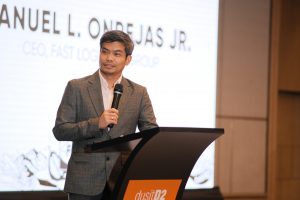
Little did anyone know that fresh graduate Manuel “Manny” L. Onrejas Jr. would spend his entire career with the Chiongbian family’s FAST Logistics Group, rising through the ranks over 27 years to become a visionary executive and, arguably, the most passionate leader FAST has ever produced.
A product of San Carlos University in Cebu, Manny started an entry-level role as a systems engineer and evolved into a career defined by transformation, innovation, and purpose.
In 2022, Manny was appointed CEO for Logistics, leading FAST’s expansion into one of the country’s foremost integrated end-to-end logistics and supply chain providers.
Building a logistics powerhouse
From its roots in William Lines, one of the country’s leading shipping companies, the Chiongbian family pivoted into the Philippines’ largest third-party logistics provider. Today, Fast Logistics offers a comprehensive suite of logistics solutions that connects businesses to markets across the archipelago.
With more than five decades of industry experience, FAST’s network spans 94 provinces nationwide. It operates the country’s largest transport fleet, with more than 3,100 trucks and over 900 trucking partners, supported by strong relationships with shipping lines and airline carriers. The company also manages one of the largest warehouse networks in the Philippines, covering more than two million square meters of space and over one million pallet positions across 160 hubs, including cold-chain facilities.
As it continues to expand, FAST has committed to achieving Net Zero Carbon emissions by 2050 through the gradual transition of its energy supply to sustainable solar power.
Despite macroeconomic headwinds, the company also sustained strong revenue growth.
“We’re targeting continued double-digit revenue growth across our core business units, while pushing hard on efficiency — higher asset utilization, better warehouse productivity, sharper route optimization, and stronger customer-service metrics,” Manny said.
The rise of logistics
The rise of logistics to prominence in corporate boardrooms is something that Manny can demonstrate with a hint of sarcasm.
For years, he said, logistics was treated as a support function—necessary but rarely celebrated. Its role was largely invisible, its contribution often overlooked. Logistics was viewed as a necessary but under appreciated function operating quietly in the background. For years, the boardrooms reduced logistics to trucks, warehouses, and drivers, failing to see the complex supply chains that kept businesses running.
Then came the COVID-19 pandemic.
Global supply chains seized up. Shortages emerged. Businesses struggled to move products. The disruptions were compounded by geopolitical conflicts, tariff disputes, and a series of global shocks that exposed the fragility of supply chains.
Manny summarizes the new reality with one acronym: VUCA — volatility, uncertainty, complexity, and ambiguity.
“Severe weather events, geopolitical tensions affecting fuel, and post-pandemic shifts in consumer behavior have taught the C-suite a hard lesson — a fragile supply chain is an existential threat,” he said.
Suddenly, logistics was no longer invisible.
“The pandemic, in particular, fundamentally changed how leaders think. They learned that growth isn’t only about having a great product; it’s about reliably and efficiently delivering that product, every single time,” he observed.
Executives also realized that customer loyalty is increasingly won or lost at the point of delivery.
“Whether it’s making sure a supermarket shelf is never empty, or keeping a pharmaceutical product strictly temperature-controlled, logistics has moved from a back-end cost center to a front-line revenue protector. That’s why it has climbed from the loading dock to the boardroom agenda,” said Manny.
According to Manny, the industry’s central dilemma today is balancing scale with profitability. Demand continues to rise, but operators face persistent inflation, slowing manufacturing activity, volatile fuel prices, infrastructure gaps, labor pressures, and mounting sustainability requirements.
In this environment, the old playbook no longer works.
“The brute-force approach of simply adding more trucks or leasing more warehouse space is no longer enough,” he said.
Technology
One of the biggest misconceptions about logistics is that it remains a low-tech, commoditized business, according to Manny.
“In reality, modern logistics is a sophisticated, data-driven technology business,” he said. “It runs on data science, predictive analytics, IoT monitoring, and increasingly, green-energy engineering. Without deep tech integration, a modern logistics network simply cannot survive.”
More fundamentally, logistics enables commerce itself.
Every product on a store shelf, every online order, and every medicine delivered to a hospital depends on a functioning supply chain.
“It’s one of the most critical industries in any economy — it just happens to do most of its work behind the scenes.”
Recognizing this, Manny made technology adoption a central pillar of his leadership strategy upon becoming CEO. He argues that without maximizing capacity utilization through technology, rising costs can quickly erode profitability.
“The flip side is that this is exactly where the opportunity lies: the companies that can deliver visibility, flexibility, and resilience will become indispensable to their customers,” he said.
FAST is investing heavily in artificial intelligence, blockchain, predictive analytics, and advanced algorithms to improve routing, demand forecasting, inventory optimization, fleet management, and predictive maintenance.
By the first half of 2027, Manny aims to deploy the company’s most advanced integrated Warehouse Management System (WMS) by Honeywell and FarEye Transport Management System platform, featuring what he describes as a “smart decision-support” algorithm designed to improve operational efficiency across the supply chain.
To strengthen the country’s logistics competitiveness, Manny identifies four priorities for government: infrastructure, policy incentives, digitalized government services, and logistics education.
“Get these right, and we lower the cost of doing business across the entire economy — not just for logistics firms,” he urged.
People
Despite his enthusiasm for technology, Manny is emphatic that logistics will always remain a people-driven business. Technology, he said, should enhance human decision-making rather than replace it.
He believes the future belongs to organizations that successfully combine technology with human expertise.
“The winners in a disrupted global supply chain are companies that successfully marry artificial intelligence with human expertise,” he said.
“Our people are our most important asset and our best resource, and the logistics workforce is transforming — it now demands a blend of digital capability and human-centric skill.”
Notably, one of the industry’s most persistent challenges is attracting and retaining qualified drivers.
To address this, FAST established in 2019 a TESDA-accredited Driver Training Center at its Cabuyao Mega Hub.
“That’s the testament of how we care for our people. At FAST, we treat our drivers and logistics personnel not as labor, but as critical frontline professionals,” said Manny.
Drivers are supported with technology and operational systems designed to reduce stress and improve efficiency. The company also provides fair compensation, strong safety programs, continuous training, and clear career advancement opportunities.
Nearly 95 percent of FAST’s leadership team has been promoted from within.
“Retention, ultimately, isn’t only about pay. It’s about building a culture where people feel valued and are proud to build a career with us,” said Manny, who espouses “results-driven, servant leadership” style.
“Servant leadership means setting the example as leader; like be at the office prior 8 AM. I believe a leader exists to empower people, remove obstacles, and create an environment where teams can succeed.”
While he avoids micromanagement, he remains deeply engaged in operations, saying, ”I told my people — ‘be on top by being on the ground’.”
At the same time, he maintains high standards, believing that talented and disciplined people consistently exceed expectations when given a clear vision and the right tools.
Under his leadership, FAST won the Sustainability and Green Logistics Award at the inaugural SCMAP Supply Chain Excellence Awards and was named runner-up in the Improver Category of the CVC Sustainability Awards.
Beyond FAST, Manny actively contributes to the broader industry through organizations such as the DTI Supply Chain and Logistics Guild, which provides pro bono guidance to MSMEs and aspiring entrepreneurs.
The Chiongbian factor
Manny’s story is unusual in modern corporate life. FAST remains the first and only company he has worked for.
Before becoming CEO for FAST Logistics, he spent more than two decades in a succession of leadership roles, including Distribution Center Manager, Assistant Vice President for Operations, Vice President for Operations, Senior Vice President of FAST Services Corporation, and Transport Manager for FAST Distribution Corporation.
He also led FAST’s warehousing business to record growth despite major supply chain disruptions.
What kept him at FAST for nearly three decades? The answer, “the power to create and the strong support from company owners.”
Aside from the trust and freedom to do what he must do as a leader, “They (Chiongbians) really take good care of their people, even after retirement.” He also credits mentors such as former boss Manuel Granada, along with the continued support of the Chiongbian family.
Over the course of his career with FAST, Manny earned an MBA from Ateneo de Manila University and completed postgraduate certificate programs in Business Economics at the University of Asia and the Pacific, as well as Digital Supply Chain and Operations with AI at the Asian Institute of Management.
Finding purpose
For Manny, logistics eventually became more than a career. It became a calling.
The demands of the industry are relentless. Manny often remains on call around the clock, including weekends and holidays.
One Christmas Eve, while working late, Manny found himself questioning why he continued to make such sacrifices. Hungry and exhausted, he stopped at a convenience store and noticed a pregnant woman buying food. And he told himself, “This is the answer of where I am, that was the purpose.”
The moment crystallized something he had long felt but never fully articulated.
Logistics is often a thankless profession. When lives are saved, doctors receive the praise. When meals delight diners, chefs receive the credit. Rarely does anyone acknowledge the people who moved the medicines, ingredients, and products that made those outcomes possible.
“I found purpose and calling here. So, when I am tired, I go back to my purpose otherwise, I would have moved on to another job,” he said.
That realization deepened into something spiritual. “Each one of us has a purpose, I found my purpose in this industry, the unsung heroes,” he said.
“Nobody, I cannot, we cannot judge. But, at the end of the day, somebody will clap his hands up there. Well, he knows best, if you’re doing the right thing, or the wrong thing.”
“In life, there is no need for praises all the time, but at the end of the day, somebody will because he knows.”
The road ahead
Manny’s ambitions for FAST remain expansive.
“My goal is to make FAST Logistics the definitive blueprint for Industry 4.0 and sustainable supply chains in the Philippines.”
A key objective is the full realization of a closed-loop electrification ecosystem across the company’s nationwide operations.
He also sees FAST as an enabler for small and medium enterprises, providing logistics solutions that allow Filipino businesses to compete locally and globally.
“Ultimately, we want to prove a single point: that a logistics company can scale rapidly, stay highly profitable, and drive genuine environmental sustainability, all at the same time,” said Manny.
Now in his 50s, Manny increasingly sees his future role as mentoring the next generation of digital-native logistics leaders and helping Filipino brands expand across borders.
He believes the Philippines can become a leader in logistics innovation and environmental stewardship across the Asia-Pacific region.
As for his legacy, he wants it to extend beyond corporate success.
“I want it to be that we fundamentally transform Philippine logistics — from a traditional, carbon-heavy, fragmented sector into a world-class, tech-enabled, with deep sense of higher cosmic purpose to Glorify Him and sustainable ecosystem,” he said.
For Manny, success will ultimately be measured not by revenue or market share, but by the strength of the organization he helped build, the leaders he helped develop, and the contribution he made to national competitiveness and the lives of customers, employees, and communities.
That, he believes, would be a legacy worth leaving behind.