


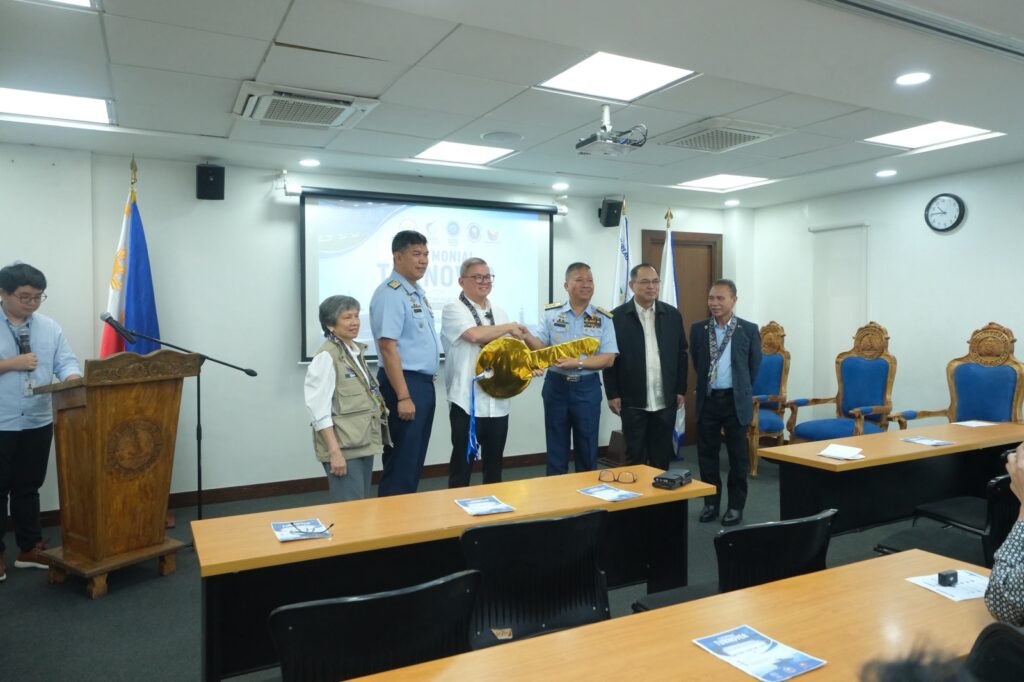
The Department of Agriculture is expanding its digital surveillance of Philippine waters, strengthening efforts to protect fisheries, combat agricultural smuggling and improve maritime security through advanced vessel monitoring technology.
Agriculture Secretary Francisco P. Tiu Laurel, Jr. and BFAR Director Elizer S. Salilig formally turned over last July 27, 2026, the Vessel Monitoring System ( VMS) workstations to National Maritime Center Director Vice Admiral Allen J. Dalangin, PCG.
The event witnessed by Presidential office for Maritime concern Secretary Andrew Centino and DA Undersecretary Drusila Bayate.
At the turnover of new VMS Workstations to the National Maritime Center, Secretary Tiu Laurel Jr. said the equipment marks a major step in modernizing fisheries enforcement under the Marcos administration.
“Today, we are turning over more than new equipment. We are strengthening our ability to protect the waters that feed our people and sustain the livelihoods of millions of Filipino fisherfolk,” Tiu Laurel said.
The Agriculture chief credited the Bureau of Fisheries and Aquatic Resources, the Philippine Coast Guard (PCG) and the Presidential Office for Maritime Concerns for turning the initiative into reality, saying the project reflects the value of interagency cooperation in protecting the country’s marine resources and coastal communities.
The workstations enable authorities to monitor the location, speed and direction of registered fishing vessels in real time, giving enforcement agencies a clearer picture of activities at sea. Beyond detecting illegal, unreported and unregulated fishing, the system will strengthen the enforcement of conservation measures such as closed fishing seasons, helping fish stocks recover and ensuring the long-term sustainability of the country’s marine resources.
Tiu Laurel also said the technology could reinforce the government’s campaign against agricultural smuggling. He noted that smugglers, now considered economic saboteurs, have increasingly used the country’s vast coastline to illegally bring in commodities such as rice, sugar and cigarettes, depriving the government of revenue while hurting legitimate farmers, fisherfolk and local industries.
“The same technology that helps us monitor fishing vessels can also strengthen our ability to detect suspicious maritime movements linked to smuggling,” he said. “These illegal activities undermine the livelihoods of our farmers and fisherfolk while allowing products that bypass quarantine and food safety inspections to reach the market.”
Tiu Laurel said access to accurate, real-time information is becoming increasingly important as climate risks intensify and pressure on marine resources grows.
“Better information leads to better decisions,” he said, adding that scientific data enables authorities to respond more quickly to threats facing fishing communities while ensuring that law-abiding fishermen are not placed at a disadvantage by those who disregard local and international rules.
“These workstations will help them see farther, act faster and coordinate better,” Tiu Laurel said. “By strengthening monitoring and enforcement today, we are helping secure our fisheries resources, protect consumers and preserve the livelihoods of future generations.”

