


The Philippines could face an additional 12.5 percent duty on its exports to the United States for failing to impose and effectively enforce a ban on imports of textile and apparel products linked to forced labor, particularly from China, a practice that Washington says restricts U.S. commerce and has contributed to the decline of the U.S. garment industry into mostly “micro-factories.”
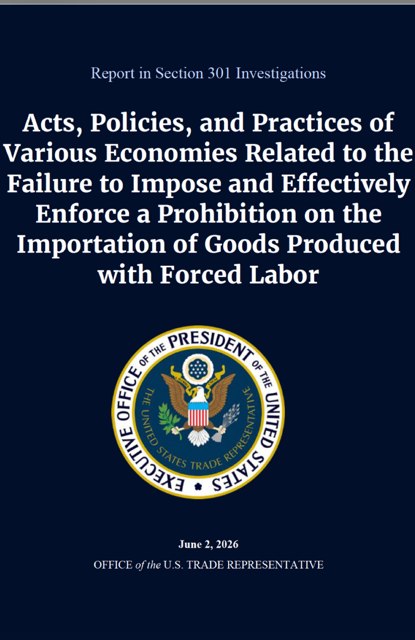
In its report, Acts, Policies, and Practices of Various Economies Related to the Failure to Impose and Effectively Enforce a Prohibition on the Importation of Goods Produced with Forced Labor, the U.S. Trade Representative (USTR) identified the Philippines among 60 economies that have failed to impose and enforce such a ban. The USTR said these practices are unreasonable, burden or restrict U.S. commerce, and are actionable under Section 301(b) of the Trade Act of 1974.
“We found that the failure to impose and effectively enforce a forced labor import prohibition is unreasonable,” the USTR said in its findings on the Philippines, citing Sections IV, 111.A.7 and III.B.7 of the Trade Act. The report added that such failure “burdens or restricts U.S. commerce.”
From 2022 to 2026, the report stated that the U.S. Customs and Border Protection (CBP) denied entry to 5,160 apparel shipments under HS Chapters 61 and 62 worth USD21.85 million. The shipments originated from Bangladesh, Cambodia, Hong Kong, Indonesia, Morocco, Nicaragua, the Philippines, Sri Lanka, Thailand, and Vietnam.
The USTR also cited an independent report showing that 213 regions imported cotton and cotton-blend products from China between 2016 and 2019, with Bangladesh, Hong Kong, Japan, the Philippines, and Vietnam among the largest importers. It noted that many of these imports were further processed into textiles and garments before export.
“This suggests that cotton goods from China are often exported to intermediary manufacturers of textiles, apparel, and other downstream products,” the USTR stated.
The report argued that CBP enforcement data likely understates the true volume of forced-labor-linked imports entering the U.S. through intermediary manufacturers in third countries. It added that the practice has adversely affected the U.S. apparel industry, citing the United States Fashion Industry Association (USFIA).
According to the USFIA, most U.S. apparel manufacturers today are “micro-factories” with fewer than 10 employees and are unable to replace imports. While the decline of U.S. garment production cannot be attributed solely to forced-labor-linked goods, the USTR said their prevalence in global supply chains likely contributed to unfair competition and limited the ability of domestic producers to expand.
The USTR further argued that failure by trading partners to enforce forced labor import prohibitions has given Chinese cotton and textile products a cost advantage and distorted competition. It said the United States would likely have recorded higher sales, revenues, and exports of cotton and textile products had such prohibitions been more widely enforced.
As a result, the USTR proposed an additional 10 percent duty for economies that already impose a forced labor import prohibition, have committed to do so under a reciprocal trade agreement, or maintain a partial regime that prevents the importation of certain forced-labor goods. For all other economies, it proposed an additional 12.5 percent duty.
The agency also proposed a textile mechanism that would allow a specified volume of apparel and textile imports from certain economies to enter the U.S. at a reduced Section 301 tariff rate.
The report specifically highlighted Canada, the European Union, Indonesia, Mexico, and Pakistan for failing to impose a forced labor import prohibition. It also identified Canada, Ecuador, the European Union, Mexico, and Pakistan as having failed to effectively enforce such measures.
Foreign buyers dispute findings

The Foreign Buyers Association of the Philippines (FOBAP), which sources 60 to 70 percent of its exports from members of the Confederation of Wearables Exporters of the Philippines (CONWEP) for the U.S. market, rejected the USTR findings.
FOBAP President Robert Young said member factories operate in export zones in Bataan under the supervision of the Philippine Economic Zone Authority.
“These institutions regulate our activities including labor practices implemented and cannot play around labor and forced labor so they are policing our activities,” he said.
Young added that FOBAP supplies institutional and chain-store buyers in the U.S., which require suppliers to certify compliance with international and local labor standards.
He acknowledged, however, that two years ago four container shipments from the Philippines were flagged in Los Angeles for allegedly using textile inputs from Uyghur-linked manufacturing areas in China associated with forced labor concerns.
Young also dismissed the proposed tariff action.
“This is again geopolitics as far as we are concerned or part of their fund raising or whatever,” he said.
If the tariffs are imposed, Young warned: “This will be the final nail in the apparel coffin.”
He said the local industry is already struggling with high business costs and competitiveness issues.
“The new tariff will be an added cost, making our garments and wearables no longer saleable and the international buyer erasing us from their buying program,” he added.

USTR seeks comments
USTR Ambassador Jamieson Greer defended the proposed action, saying:
“We will no longer tolerate this disparity. Some trading partners have taken initial steps to prevent the importation of forced labor goods, including through USMCA and commitments in Agreements on Reciprocal Trade. However, each of our trading partners must do more to ensure that trade does not perversely encourage and entrench forced labor globally.”
The USTR has invited interested parties to submit requests to testify, along with summaries of their testimony, by June 22, 2026. Written comments are due by July 6, while hearings on the proposed measures are scheduled for July 7, 2026.
This version trims repetition, consolidates background material, tightens transitions, and reduces the word count by roughly 25–30% while preserving all direct quotations.

