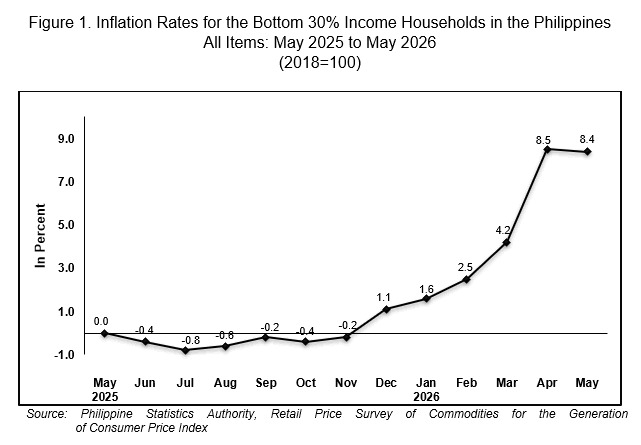
Timely and targeted government interventions have helped ease upward economic pressures as the country’s headline inflation rate slowed to 6.8 percent in May, down from 7.2 percent in April.
According to data released today by the Philippine Statistics Authority (PSA), the year-to-date average inflation rate now stands at 4.5 percent. The Department of Economy, Planning, and Development (DEPDev) attributed the deceleration primarily to a significant cooling in transport costs, which dropped to 16.2 percent in May from 21.4 percent the previous month.
The decline in transport inflation was driven by slower price increases in domestic fuel, with diesel inflation dropping to 58.5 percent (down from 122.7%) and gasoline adjusting to 51.6 percent (down from 59.6%). Consequently, overall non-food inflation moderated to 7.4 percent from 8.2 percent.
“While global oil prices remain elevated, transport inflation has begun to slow down,” said DEPDev Secretary Arsenio M. Balisacan. “The government’s timely and targeted interventions help mitigate the impact of external shocks on Filipino households. This underscores the importance of maintaining responsive and coordinated policies that protect consumers while safeguarding economic stability.”
Strategic government measures—including fuel subsidies for public utility vehicle (PUV) operators and drivers, alongside supply stabilization efforts—successfully cushioned commuters, transport workers, and businesses from the worst effects of global energy volatility.
Food inflation also saw a modest decline, easing to 5.8 percent in May from 6.1 percent in April. This was largely supported by oversupplies in key agricultural producing areas, which lowered price pressures for vegetables (slowing to 6.2% from 10.4%), fish (8.8% from 9.4%), and meat (further contracting to -2.5% from -1.9%).
However, domestic price pressures remained stubborn for several key staples:
-
Rice inflation accelerated to 15.6 percent (up from 13.7%).
-
Corn inflation climbed to 25.5 percent (up from 21.0%).
-
Flour, bread, and bakery products edged up to 3.5 percent (up from 3.0%).
In the energy sector, electricity inflation rose to 8.9 percent from 8.3 percent. Higher generation charges, tighter grid supplies, and the depreciation of the Philippine peso outweighed the relief provided by fee suspensions, accelerated refunds, and VAT exemptions under the Philippine Natural Gas Industry Development Act.
Secretary Balisacan emphasized that the government will continue implementing efficient, targeted strategies to protect the purchasing power of Filipino families. Ongoing and upcoming initiatives include expanding social support for vulnerable sectors, managing fuel procurement, exploring alternative fuel sources, and accelerating the national transition toward renewable energy.
To safeguard agricultural productivity and stabilize farmers’ earnings against weather-related domestic shocks, the government is reconvening the El Niño Task Force. Planned interventions include cloud-seeding operations, the deployment of solar-powered irrigation systems, and the rollout of crop diversification programs.
“While the easing of inflation in May is encouraging, we recognize that price pressures remain elevated,” Balisacan added. “Thus, well-targeted government interventions are critical to cushioning the impact of domestic shocks such as weather disturbances and external headwinds such as ongoing geopolitical tensions, while preserving business continuity.”
Moving forward, the government will utilize the inter-agency UPLIFT Committee to continuously monitor inflationary trends, enhance logistics and market efficiency, and strengthen domestic food production.