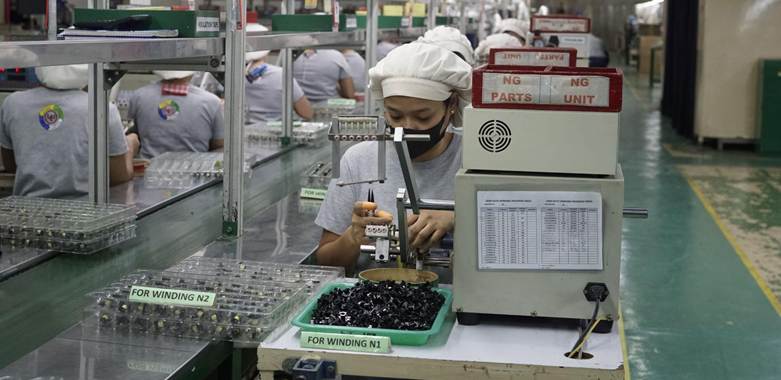
The United States and the Philippines also announced their plans to establish a 4,000-acre industrial hub in the Luzon Economic Corridor of the Republic of the Philippines.
This developed as Trade and Industry Undersecretary and Managing Head and Vice Chairperson of the Board of Investments Ceferino S. Rodolfo signed on April 16, 2026 the declaration reflecting the Philippines’ participation in the Pax Silica.
In a media note, the U.S. Embassy in the Philippines said that the industrial hub, the first of its kind, is being offered by the Philippines as an Economic Security Zone, to surge production for inputs vital to U.S. supply chains.
It is intended to serve as a staging point for a purpose-built platform for allied manufacturing, an investment acceleration hub where specific industrial activities can be shaped by market demand, host-country comparative advantages, and the evolving needs of the Pax Silica network.
The Philippines joined the Pax Silica initiative, launched by the United States and thirteen other nations, hailing a growing geopolitical consensus that economic security is national security and national security is economic security. The Philippines, a close U.S. treaty Ally, brings to Pax Silica key capabilities and human talent in technology manufacturing, including semiconductors and electronics.
The Pax Silica initiative is a United States-led strategic coalition launched in December 2025 designed to secure, diversify, and strengthen supply chains for semiconductors, artificial intelligence (AI) technology, and critical minerals.
Through the United States-Philippines Critical Minerals Framework and the Luzon Economic Corridor – and as the two countries commemorate 80 years of diplomatic relations – the two allies are committed to strengthening shared supply chains in critical minerals, semiconductors, electronics, and other goods and attracting high-quality private sector investment critical to Pax Silica.
The United States welcomed the Philippines as the thirteenth Pax Silica signatory. It joins fellow signatories Australia, Finland, India, Israel, Japan, Qatar, Republic of Korea, Singapore, Sweden, the United Arab Emirates, the United Kingdom, and the United States. Additional signatories are expected to follow.