


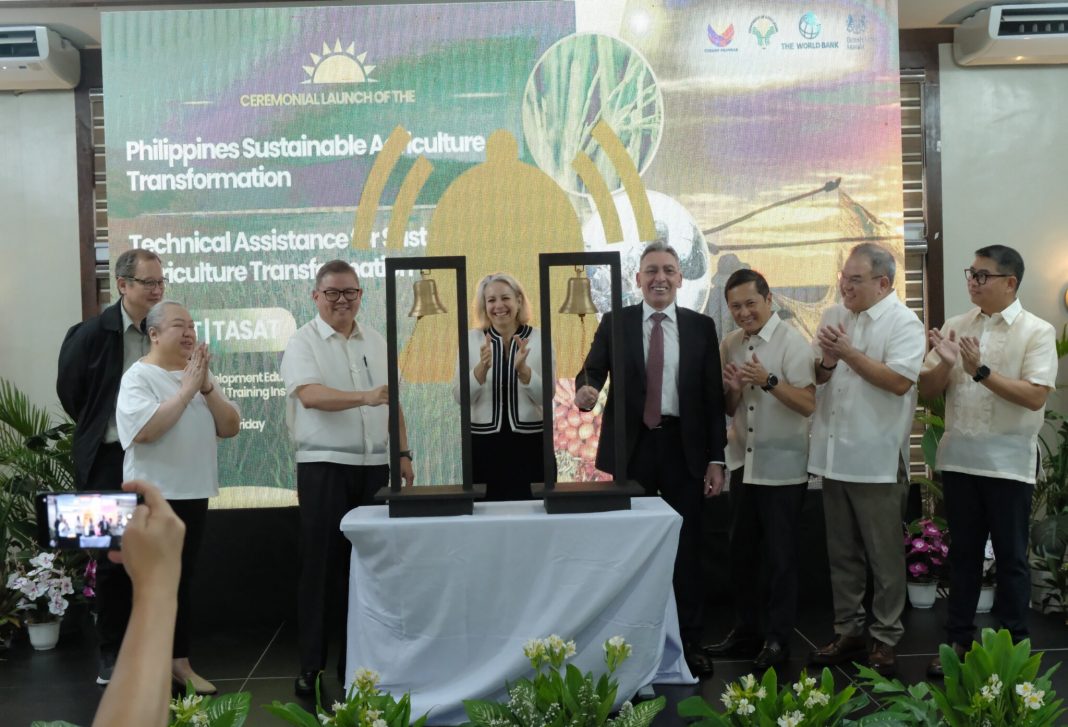
The Department of Agriculture (DA) on Friday, May 15, unveiled the Philippine Sustainable Agriculture Transformation (PSAT) Program, backed by a USD1-billion World Bank (WB) financing package, aiming to modernize the country’s agriculture, boost productivity, and strengthen food security.
PSAT marks the Philippines’ first project under the World Bank’s Program-for-Results (PforR) model, which releases funds based on measurable outcomes rather than upfront disbursements. The project is a vote of confidence in the DA’s reform agenda and a shift toward results-driven development financing.
“This financing allows us to raise farm productivity, stabilize food supply, and protect millions of livelihoods dependent on agriculture. By strengthening value chains and building climate resilience, we are supporting rural incomes and reinforcing a key pillar of the economy,” said Agriculture Secretary Francisco P. Tiu Laurel Jr.
The program targets three result areas: An increase in rice-based farming output, enhancement of efficiency and climate resilience in value chains, and improvement in institutional performance.
By linking farm productivity with supply chain upgrades and governance reforms, PSAT seeks to deliver measurable, end-to-end results across the full agricultural value chain.
A key feature is its use of disbursement-linked indicators (DLIs), which require the government to meet verifiable targets before accessing funds. While this may slow initial disbursements, it enforces accountability and outcome-driven execution.
The government anticipates an initial USD300 million release in 2026, providing fiscal support amid energy pressures and climate-related challenges.
“These programs will help at least five million farmers diversify livelihoods, increase income, and manage climate risks. Rural communities will benefit from modernized services, stronger value chains, and a more resilient food system,” Zafer Mustafaoğlu, World Bank Division Director for the Philippines, Malaysia, and Brunei.Complementing the loan is a USD24.5-million Technical Assistance for Sustainable Agriculture Transformation (TASAT) grant, including a USD14.5 million contribution from the UK through its Just Rural Transition Support Programme—underscoring a dual strategy of large-scale investment paired with capacity building.
During the project’s launch, British Ambassador Sarah Hulton OBE highlighted the vital intersection of agriculture with climate change, food security, and economic growth, emphasising the urgency of transformative action. “Agriculture sits at the crossroads of climate change, food security and economic growth. As farmers face stronger typhoons, floods and disrupted supply chains, transforming agriculture is not just a technical task—it is a strategic necessity. That is why the UK, together with the World Bank, is investing in TASAT to raise incomes, stabilise food supplies and strengthen climate resilience while protecting land and nature,” said Ambassador Hulton.
DA Assistant Secretary Arnel de Mesa said that PSAT and TASAT could become a test case for results-based financing in the Philippines, emphasizing measurable impact over mere fund availability.

