


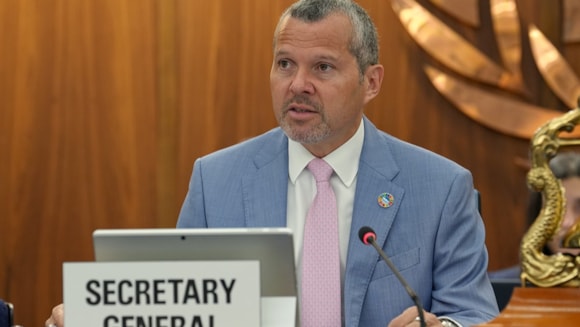
Speaking at the 137th session of the International Maritime Organization (IMO) Council, Secretary-General Arsenio Dominguez issued an urgent plea for the safety of civilian shipping, revealing that a vital evacuation plan in the Strait of Hormuz has been forced to a halt due to escalating security risks.
The statement, delivered under Agenda Item 16 (“Protecting Vital Shipping Lanes”), highlighted both the human cost of the ongoing regional conflict and the severe economic strain facing the global maritime industry.
Following directives from the Council’s 36th extraordinary session, the IMO—in collaboration with regional partners, notably the Sultanate of Oman—successfully launched an emergency evacuation framework in late June. Utilizing two alternative routes to bypass a mine-ridden Traffic Separation Scheme, the operation safely extracted 136 vessels and 2,900 seafarers.
However, the Secretary-General announced that the operation has been paused because the safety of personnel can no longer be guaranteed. The volatility of the region was underscored just yesterday when three merchant vessels were struck while transiting the southern corridor. While no casualties were reported, the incidents underscore the perilous environment.
“Approximately 6,000 seafarers remain trapped in the region,” the Secretary-General stated. “I am still seeking guarantees that vessels can evacuate the Strait of Hormuz using either of the alternative routes provided without the risk of threats of attack.”
Secretary-General Dominguez emphasized that the crisis is fundamentally a humanitarian one, noting that innocent seafarers have already tragically lost their lives.
Key demands & observations from the address:
-
Protection of Seafarers: The IMO reiterated that freedom of navigation is a fundamental pillar of international law. Civilian ships and their crews must never be used as geopolitical leverage.
-
Inflated Insurance Costs: The Secretary-General called out the unsustainably high cost of maritime insurance in the region. Despite shifting conditions, market pricing has failed to adjust downward from peak-crisis levels.
-
Call to Governments: Nations with influence over reinsurance markets are urged to engage with insurers to lower premiums, which are currently driving up freight costs and disproportionately harming developing regions reliant on maritime trade.
While the IMO Secretariat continues to work through United Nations channels to build regional emergency response capacities, the immediate focus remains on de-escalation and dialogue.
In closing, the Secretary-General urged all flag States, shipowners, and operators to exercise extreme caution, mandate rigorous risk assessments, and avoid any operational decisions that put seafarers’ lives in jeopardy.

