


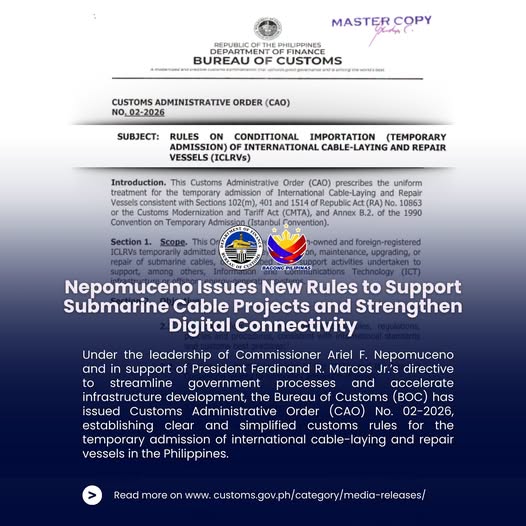
Under the leadership of Commissioner Ariel F. Nepomuceno and in support of President Ferdinand R. Marcos Jr.’s directive to streamline government processes and accelerate infrastructure development, the Bureau of Customs (BOC) has issued Customs Administrative Order (CAO) No. 02-2026, establishing clear and simplified customs rules for the temporary admission of international cable-laying and repair vessels in the Philippines.
Through the new CAO, the BOC established a clear and transparent framework governing the temporary admission of International Cable-Laying and Repair Vessels (ICLRVs) used for the survey, installation, maintenance, upgrading, and repair of submarine cable systems, including seabed cable-support activities for Information and Communication Technology infrastructure and offshore energy-generation systems.
The regulation aligns Philippine customs procedures with international standards under the Customs Modernization and Tariff Act (CMTA) and the Istanbul Convention, while helping reduce delays and operational costs for critical infrastructure projects.
Under CAO No. 02-2026, qualified foreign cable-laying and repair vessels may temporarily enter the country without paying import duties and taxes, provided that they are used exclusively for authorized submarine cable projects and are re-exported after completing their operations.
The Order also introduces simplified procedures for vessels staying in Philippine waters for short periods, allowing faster processing and reducing administrative requirements while maintaining customs supervision and compliance safeguards.
In addition, the regulation allows these vessels to move between project sites and ports without repeatedly filing new import documents, making operations more efficient for large-scale infrastructure projects that cover multiple locations.
The Bureau emphasized that while the vessels themselves may receive temporary duty and tax relief, materials such as cables, pipes, and other imported equipment remain subject to existing customs laws and importation requirements.
Commissioner Nepomuceno said the issuance reflects the Bureau’s commitment to supporting national development through modern and responsive customs policies.
“This initiative helps create a more efficient environment for projects that improve the country’s digital connectivity and critical infrastructure. By streamlining customs procedures while maintaining proper safeguards, we are supporting investments that benefit businesses, communities, and the Filipino public,” Commissioner Nepomuceno said.
The reform likewise reflects the Bureau’s Integrity, Accountability, and Modernization (IAM) Movement, ensuring transparent processes, responsible implementation, and modernized, technology-driven systems that support key national infrastructure projects.
The CAO No. 02-2026 was officially published on July 2, 2026, and will take effect on July 17, 2026, or fifteen (15) days following its official publication.

