


Food Industry Asia (FIA), a non-profit association representing major food and beverage manufacturers and ingredient suppliers in the region, has urged the government to recalibrate policies related to the country’s food nutrient profile model, warning that the measure could further disrupt supply chains and distribution in a domestic food sector heavily reliant on imports. The group also raised concerns about the timing of the policy’s implementation.
Anna Beatrice Baldonado, FIA public affairs manager in the Philippines, made the remarks while presenting the study “The Economic Impact of the Agri-Food Sector in the Philippines.” The study was conducted by FIA in partnership with Oxford Economics and the ASEAN Food and Beverage Alliance.
The Philippine Nutrient Profile Model (PNPM) is a government-led tool developed by the National Nutrition Council (NNC) and the DOST-Food and Nutrition Research Institute (FNRI) to classify packaged foods and beverages according to their levels of sugar, sodium, saturated fat, and trans fat. The measure aims to curb rising non-communicable diseases (NCDs) by regulating marketing to children, guiding product reformulation, and implementing front-of-package warning labels.
However, Baldonado warned that the PNPM is a broad policy tool that could affect various aspects of the agri-food sector, including taxation and supply chains.
She said the PNPM goes beyond simply classifying packaged foods and beverages. “The food chamber feels the proposal is too restrictive,” she said, adding that it could be used to regulate advertising, social media, and taxation, with broader implications for the country’s agri-food sector.
While FIA has appealed for a careful recalibration of the policy, the PNPM has reportedly already been approved by the NNC.
Baldonado also questioned the timing of the policy, citing the ongoing global energy crisis, elevated food prices and inflation, geopolitical tensions, and political instability.
According to the FIA study, the updated 2025 analysis highlights the food manufacturing and distribution sector’s critical and evolving contribution to trade, investment, and competitiveness in the Philippines.
The study underscored the industry’s vital role in sustaining livelihoods and supporting economic progress for millions of Filipinos.
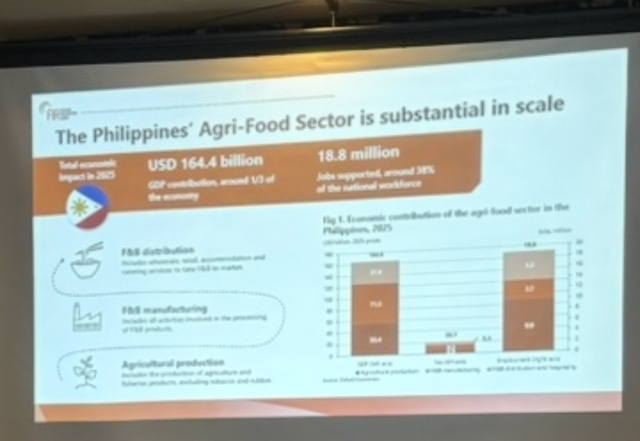
It found that the country’s agri-food sector is a cornerstone of the Philippine economy, contributing USD164.6 billion to GDP, equivalent to 33 percent of the national economy. The sector is also projected to employ 18.8 million people, or 38 percent of total national employment, in 2025.
In agricultural production alone, the sector contributes USD55.4 billion to GDP and supports 9.9 million jobs. Meanwhile, the food and beverage manufacturing sector contributes USD71 billion to GDP and employs 3.7 million people.
Within the supply chain, food and beverage distribution contributes USD37.9 billion to GDP and supports 5.2 million jobs.
The analysis emphasized the critical role of food manufacturing and efficient distribution systems in the broader agri-food value chain. These segments are essential to maximizing agricultural output, creating added value through processing, and ensuring the timely and widespread delivery of food products across the archipelago.
Given these substantial contributions, the report underscored the need for policymakers to thoroughly assess any proposed measures that could affect the food manufacturing and distribution sector. It said careful evaluation is necessary to ensure that new regulations, including potential food restriction policies, do not unintentionally hamper the sector’s growth, weaken its resilience, or negatively affect livelihoods supported by the industry.
The report added that the findings provide a strategic framework for understanding how the Philippines can continue leveraging its food manufacturing and distribution industry to drive sustainable growth and strengthen resilience amid a rapidly evolving regional and global economic landscape.

